
- Write one line on what the group is for before drafting any rules, then keep to around seven plain ones.
- Leave out vague or overly strict rules, since both fail and make the group quieter rather than more useful.
- Have more than one moderator, remind people privately first and apply the rules consistently.
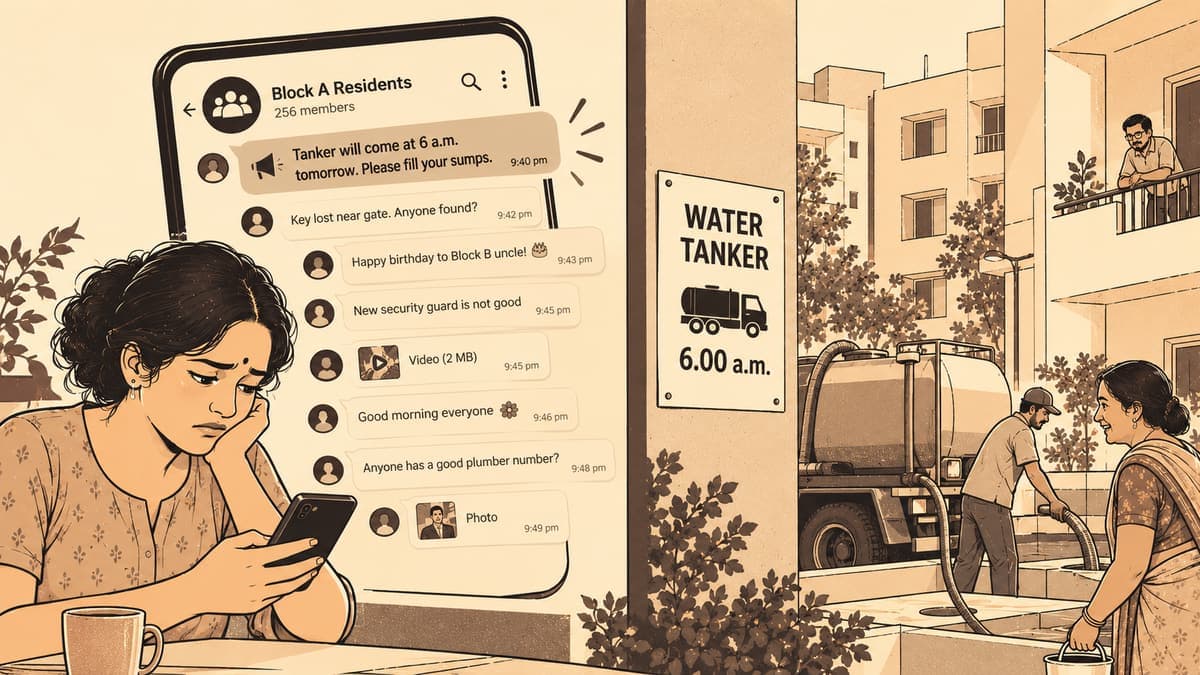
Most neighbourhood groups start without rules. A few families in a new apartment block in Perungudi make a group to sort out the lift contract, and it works beautifully for a month. Then someone forwards a political video. Someone else posts a saree sale every morning. Two residents argue about car parking until midnight. By the third month, half the members have muted the group and the people who actually need to hear about the water tanker don't.
Rules don't fix everything, but good ones prevent most of that. The trick is writing rules people will read, remember and accept, rather than a long notice nobody opens.
This guide is for anyone who runs or helps run a neighbourhood or apartment group: RWA committee members, colony volunteers, or the one resident who ended up as admin because they created the group. It covers what to put in, what to leave out, and how to enforce rules without becoming the colony villain.
Start with what the group is for
Before writing a single rule, answer one question in a line: what is this group for?
- "Day-to-day matters for residents of Lotus Apartments, Block C."
- "Neighbours on 3rd Cross Street, Besant Nagar, helping each other out."
- "Weekend cyclists from Velachery and nearby."
Every rule after that should protect that purpose. If a post helps residents with day-to-day matters, it belongs. If it doesn't, it probably belongs somewhere else. This one line also helps when there's a disagreement: you're not saying "I don't like your post", you're saying "this group is for something else".
Seven rules most neighbourhood groups need
You don't need twenty rules. Most groups do well with around seven, written plainly:
- Be kind, even when you disagree. Criticise ideas, not people. No comments on anyone's religion, caste, language, looks or family.
- Stay on topic. Keep the main chat for things that affect everyone. Use the right group for parking, pets or kids.
- No forwards. No good-morning images, political videos or unverified "share this urgently" messages.
- Selling goes in Buy & sell. One post per item. No repeated reminders.
- Respect privacy. Don't post another resident's door number, phone number or photos of their home without asking.
- Complaints go to the right person. Raise maintenance issues in the Maintenance group or Help desk, not as a public argument.
- Admins will step in when someone keeps breaking these rules, starting with a friendly reminder.
Short, numbered rules work better than paragraphs. People can quote "Rule 3, please" in a friendly way instead of writing a lecture.
What to leave out
Rules that are too vague or too strict both fail.
Too vague: "Maintain decorum." Everyone thinks they already do. Say what you actually mean, such as no shouting in capitals, no personal attacks.
Too strict: "No messages after 9 pm." Then a pipe bursts at 10 pm and someone hesitates to tell the block. Instead, encourage people to mute the group at night if they wish.
Too legal: Long clauses about liability and jurisdiction read like a threat. A neighbourhood group isn't a contract. If your association has formal bylaws, link to them separately.
Also avoid rules you won't enforce. A rule nobody follows teaches members that none of the rules matter.
Enforcing rules without becoming the villain
The hardest part of running a group isn't writing rules. It's applying them to the aunty who has lived in the building for twenty years.
A few habits that help:
- Have more than one moderator. Two or three admins from different floors or blocks share the load and the blame. No single person looks like they're targeting anyone.
- Remind privately first. A message like "Hi, could you move sale posts to Buy & sell? Thanks!" works better than a public telling-off.
- Be consistent. If the committee president's forward gets a reminder, so does everyone else's. Members notice fairness more than strictness.
- Keep it brief when you step in. "Gentle reminder: Rule 3 (forwards)." No sarcasm, no debate.
- Review the rules once a year. At the AGM or after Pongal, ask members what's not working.
For serious problems, such as scams, harassment or someone pretending to be a committee member, admins aren't alone. Members can report content, and reported content is hidden after reports and reviewed by the team. See how reporting and blocking keep a community friendly for when to use which.
Where Zinola fits
On Zinola, a neighbourhood or apartment group is a circle, and it's set up with rules and roles in mind:
- Circle rules of up to 3,000 characters, enough for a purpose line and seven clear rules, with room for a few notes.
- An owner and moderators ("admins") who look after the circle, plus members.
- An admin-only Announcements group, so the committee's notices on maintenance dues or the AGM date don't get buried.
- Up to 20 groups inside a circle, such as Maintenance, Parking, Kids & parents or Pets, so "stay on topic" is easy to follow. Groups can be open, private (ask to join) or admin-only posting.
- Automatic Buy & sell and Polls & events rooms, which keep sales and plans out of General.
- Join questions and invite links that can be limited or set to expire, so the people joining are the people the circle is for.
- Open, closed or invite-only circles, depending on how private the group should be.
Your circle's own rules sit alongside Zinola's community rules, which apply everywhere on the app. If you're setting up for the first time, the guide on starting a circle for RWAs and apartments walks through it step by step, and ideas to encourage participation help once it's running.
A simple test for any rule
Before adding a rule, ask: will this make the group more useful for the person who just needs to know when the tanker is coming? If yes, keep it. If it only makes the group quieter, tidier or more like the admin wants, think again.
Kind and useful is the whole goal. The rules are just there to protect it.
Questions people ask
- How many rules should a neighbourhood group have?
- Most groups do well with around seven short, numbered rules plus a one-line purpose. Fewer, clearer rules are easier to remember and enforce.
- How long can circle rules be on Zinola?
- A circle's rules can be up to 3,000 characters.
- Who enforces rules in a Zinola circle?
- Each circle has an owner and moderators who look after it. Members can also report content, which is hidden after reports and reviewed by the team.
- Do Zinola's own rules apply inside circles?
- Yes. Zinola's community rules at /rules apply everywhere on the app, and each circle can add its own rules on top.
Start a circle with rules built in
Set up a free circle for your apartment or street, add your rules and pick your moderators.
Start a circle