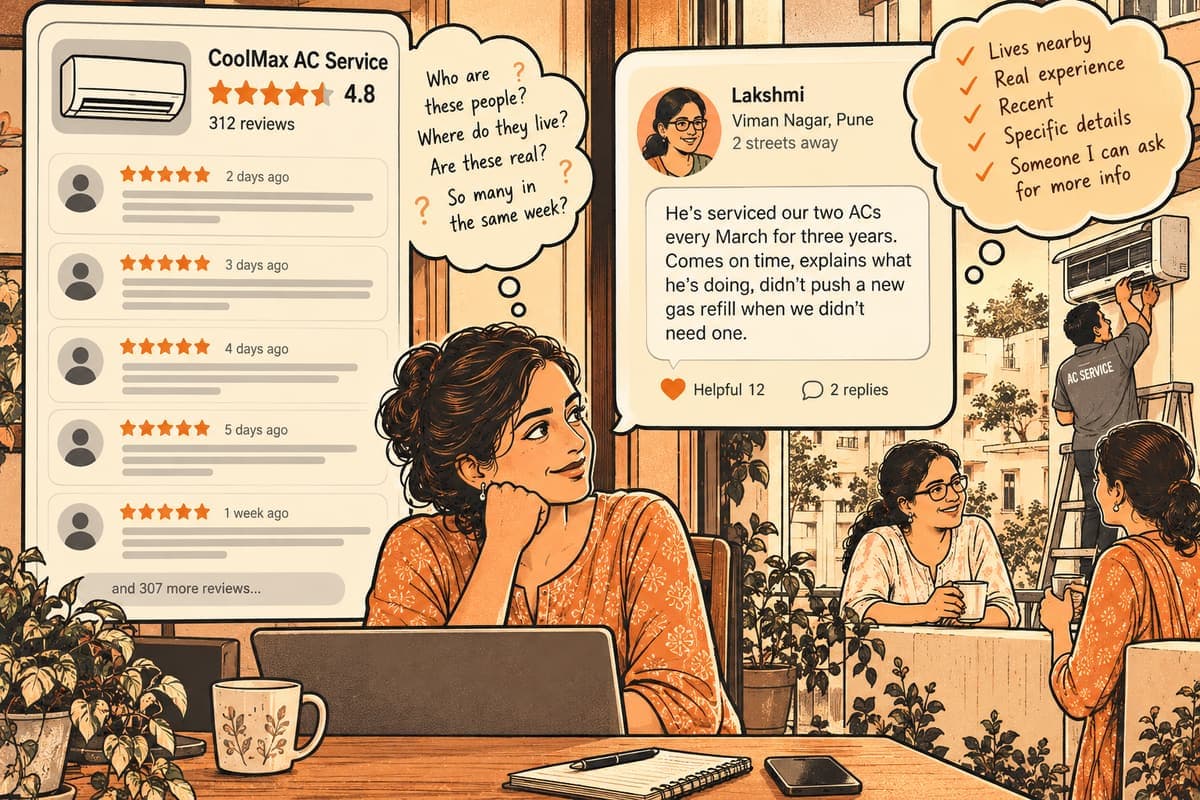
- Anonymous ratings hide who wrote them, where they live and whether their reputation is at stake.
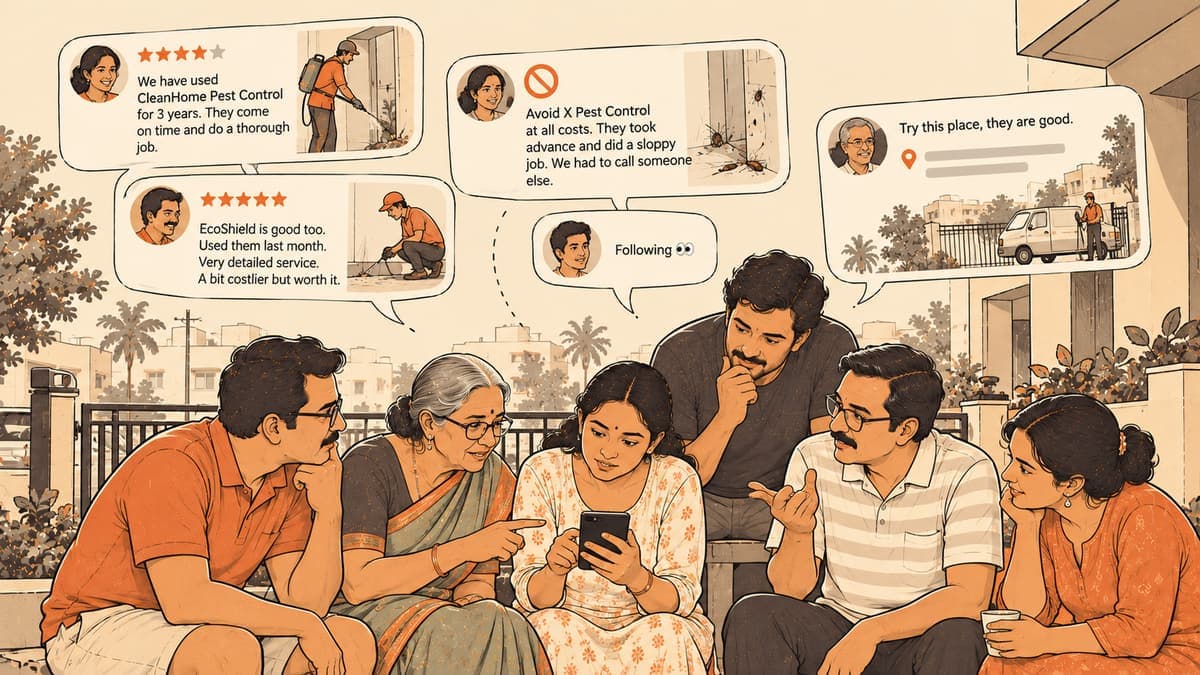
- A named neighbour's recommendation lets you see their profile and ask a follow-up question.
- Even a trusted neighbour's word is a starting point, not a guarantee, so still check for yourself.
Picture two recommendations for an AC service technician. The first is a 4.8-star rating on a listing site, from 312 reviewers you'll never meet, many of them posted in the same week. The second is a reply from Lakshmi, who lives two streets away in Viman Nagar, Pune: "He's serviced our two ACs every March for three years. Comes on time, explains what he's doing, didn't push a new gas refill when we didn't need one."
Most of us trust the second one more, even though it's one voice against hundreds. That instinct is sound. A recommendation is only as useful as your ability to judge the person giving it, and you can judge Lakshmi. You may even know her.
This article looks at why a name and a nearby address make advice more reliable, how to weigh what neighbours tell you, and how to give recommendations that others can trust in turn.
Why anonymous ratings are hard to judge
Star ratings aren't useless, but they hide most of what you'd want to know.
- You can't tell who wrote them. A five-star review from someone who hired a painter for one wall and one from someone who had a whole 3BHK done count the same.
- You can't tell where they live. A plumber who's brilliant in Ballygunge may not come to the other end of Kolkata at all, or may charge extra to.
- You can't ask a follow-up question. "Did he leave the bathroom clean?" "Did the quote change halfway?" A rating can't answer.
- Nobody's reputation is at stake. An anonymous reviewer loses nothing if they exaggerate, or if they're a friend of the owner.
A named neighbour has something to lose. If Lakshmi sends you to a bad technician, you'll mention it at the next residents' meeting. That small bit of accountability changes how carefully people recommend.
What makes a recommendation worth trusting
Not every named recommendation is equally useful either. When a neighbour suggests someone, look for these signs:
| Sign | Why it matters |
|---|---|
| First-hand experience | "We used him" beats "my cousin says he's good". |
| Recent | A tailor who was great in 2019 may have changed staff since. |
| Specific details | "Fixed the leak under the kitchen sink in an hour" tells you more than "very good". |
| Nearby | Someone in your area knows whether the person actually comes here, and how they handle local problems like hard water or low-voltage evenings. |
| Repeat use | "We've called her every Diwali for deep cleaning" means trust built over time. |
| Mentions a downside | "Good work, but always 30 minutes late" sounds like an honest account, not a favour. |
Two or three recommendations with these signs, from different people, are worth far more than a long list of stars. Our earlier piece on how to judge local recommendations goes deeper into weighing advice.
How to give a recommendation people can rely on
The same logic works the other way. When you recommend someone, you're lending them a little of your name. Make it count:
- Say what they did for you. "Replaced the switchboard in our hall and fixed two loose sockets."
- Say when. "Last month" or "every summer since 2022".
- Be honest about the downside. If they're a bit pricey or hard to reach on weekends, say so.
- Only recommend people you've actually used. If you're passing on someone else's tip, say that clearly.
- Don't recommend relatives without saying so. It's fine to suggest your brother-in-law's catering, as long as everyone knows he's your brother-in-law.
- Update people if things change. If the person you suggested lets someone down, a short follow-up is fair to everyone.
None of this needs long essays. Three honest sentences are enough. See your experience could help someone in your neighbourhood for more on writing useful reviews.
The limits of trust
A good neighbour's word is a strong starting point, but it isn't a guarantee. People's experiences differ, and a helper or tradesperson can have a bad month.
So still do the basics: meet the person before handing over keys, agree the price and scope before work starts, and avoid paying large sums in advance to someone you've never met. For specific trades, the guides on finding a reliable plumber and checking a local business before you hire have practical checklists.
Where Zinola fits
Zinola is built so recommendations come from people around you, with a profile you can look at, rather than from nowhere:
- Ask your neighbourhood. Ask a question from the + menu, or use "Recommend someone" to share a name you trust. Answers neighbours agree with rise to the top, and the person who asked can mark the answer that sorted it.
- @-tag a neighbour or a business in a reply, so the person or business being recommended is one tap away.
- Trusted helpers in your circle. Members can vouch for a maid, plumber or cook with "I use them too", and the numbers are visible to members only. These are neighbours' vouches; Zinola doesn't run checks on the helpers.
- Business reviews from real accounts. One review per person, with overall stars plus six areas (Quality, On time, Updates, Price, Ownership, Attitude). The owner can reply once in public, and nobody can pay to remove a review. Browse them on businesses.
- Commendations, not ratings, for people. Neighbours can commend each other as Helpful, Welcoming, Reliable or Kind. There are no star ratings of individuals.
Trust is local, and it's earned
The best recommendation systems in Indian neighbourhoods were never apps. They were the vegetable vendor who knew which electrician was honest, the building watchman who knew which maid was reliable, and the aunty upstairs who'd tried every tailor in the area.
A neighbourhood app works when it keeps that same quality: real people, real streets, real experience. Put your own name to what you share, weigh others by the same standard, and your neighbourhood's advice gets better for everyone.
Questions people ask
- Why trust a neighbour's recommendation over online ratings?
- You can see who the neighbour is, ask follow-up questions, and they know whether the person actually works in your area. Anonymous ratings can't tell you any of that.
- Does Zinola vet the Trusted helpers in a circle?
- No. Trusted helpers are vouched for by circle members with "I use them too"; Zinola does not run checks on them. Their numbers are visible to circle members only.
- Can a business pay to remove a bad review on Zinola?
- No. Nobody can pay to remove a review. Each person can leave one review, and the owner can reply once publicly.
- Can I rate a person on Zinola?
- No. There are no ratings of individual people. Neighbours can give commendations instead: Helpful, Welcoming, Reliable or Kind.
Ask the people around you
Post a question to your Chennai neighbourhood on Zinola and hear from neighbours who've actually used the service.
Get the app