- Report, block, mute and reply are four tools for four different kinds of problems.
- Report spam, scams, harassment and impersonation, and block when the issue is between you and one person.
- A friendly space depends on many small choices by members, since no team can read every message.
Every neighbourhood has one. The person who replies to every post about the stray dogs with something sharp. The account that suddenly starts posting "work from home, earn ₹50,000 a week" in the Buy & sell room. The neighbour who keeps messaging you after you've said, politely, that you're not interested in their offer.
Most of the time, a neighbourhood space is friendly because most people are friendly. But a few bad moments can make everyone go quiet, and a quiet community is not much use when you need a plumber at 9 pm during a monsoon downpour.
That's why reporting and blocking exist. They're not about punishing people. They're small tools that let ordinary members keep the space useful without waiting for someone else to step in. This article explains when to use each, what to expect afterwards, and how to handle the grey areas.
Report, block, mute or just reply: which one?
It helps to think of these as four different tools for four different problems.
| Situation | Best tool |
|---|---|
| A post that is spam, a scam, harassment or pretending to be someone else | Report it |
| One person who keeps bothering you personally | Block them |
| A busy group chat that's too noisy for you right now | Mute it |
| A neighbour who is wrong, rude once, or just disagrees | Reply calmly, or let it go |
The last row matters. Reporting is for content that breaks the community rules, not for opinions you don't share. If someone in Porur thinks the colony should spend the maintenance fund on CCTV and you think it should go to rainwater harvesting, that's a discussion, not a report.
When to report, and what counts
Report a post or message when it's clearly harmful to the community. On Zinola, the reasons you can pick include spam, harassment, scam and impersonation, among others. Some everyday examples:
- Spam: the same "loan in 10 minutes" message pasted into every room.
- Scam: a marketplace listing for an iPhone at a third of its price, where the seller insists on an advance before you see it.
- Harassment: repeated personal attacks, or comments about someone's looks, caste, religion or family.
- Impersonation: an account using your RWA secretary's name and photo to collect "maintenance dues".
When content is reported, it's hidden after reports and reviewed by the team. You don't need to argue in the comments or rally others to report the same post. One clear report with the right reason does its job.
A good habit: report first, then step away. Replying to a scam post to warn others often keeps it visible longer in people's minds, and arguing with a harasser rarely changes them.
When to block
Blocking is personal. It's for when the problem is between you and one person, rather than something the whole community needs to see dealt with.
Say you sold a bookshelf in Tambaram, and the buyer keeps messaging you weeks later about a "discount on the next item", even after you've said no twice. They may not have broken any rule. But you don't owe them more of your time. Block them and move on.
Block is also the right step if someone you followed back turns out to be someone you don't want in your life, or if an old disagreement keeps spilling into new posts. It's your space; you get to decide who's in it.
The grey areas
Not everything is clear-cut. A few situations people often ask about:
"It's a real business, but they post too much." A tailor in T. Nagar sharing her new blouse designs once a week is useful. The same post three times a day is noise. If it's inside a circle, a quiet word to the circle's admins is often better than a report. They can set limits in the circle's rules.
"Someone shared my old post with a rude comment." If it's a personal attack, report it as harassment. If it's just criticism, a calm reply or no reply usually works better.
"I think this listing might be a scam, but I'm not sure." Ask questions in a private enquiry first. Ask to see the item in person. If the seller refuses and pushes for money upfront, report the listing and don't pay. Remember that Zinola doesn't handle payments, so any advance you send goes straight to the seller, with nothing in between.
"My neighbour is being rude to me in the apartment General chat." If it's a one-off, let it go or reply calmly. If it continues, tell the circle's admins and, if needed, block or report.
Where Zinola fits
Zinola gives every member the same simple tools, and a few that help groups look after themselves:
- Block and report, with report reasons including spam, harassment, scam and impersonation.
- Reported content is hidden after reports and then reviewed by the team.
- Community rules for everyone are published at /rules.
- Circles have their own rules of up to 3,000 characters, plus an owner and moderators who can look after the group.
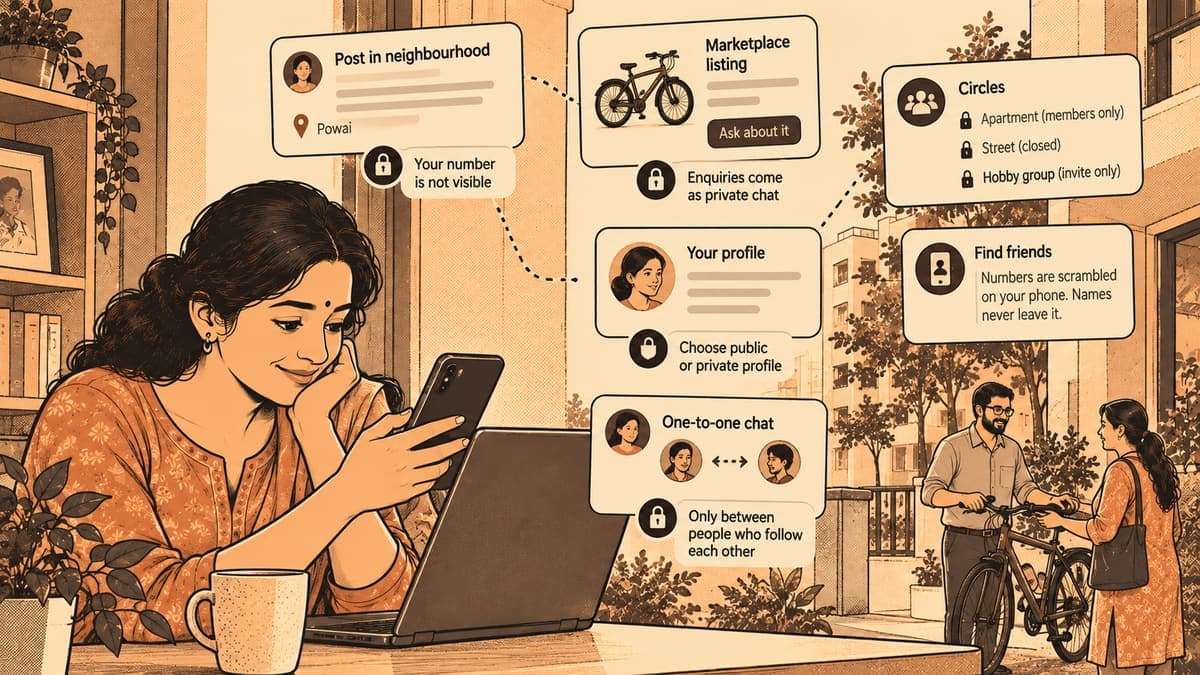
- One-to-one chats are only between people who follow each other, so strangers can't simply start messaging you.
- Marketplace enquiries keep numbers hidden, so a bad buyer doesn't end up with your mobile number.
- Chats can be muted when a busy group gets too loud.
If you run a circle, our guide on community rules that work covers how to write rules that people actually follow, and what stays private on Zinola explains how your number and profile are protected to begin with.
A friendlier space is a shared job
No tool makes a neighbourhood space perfectly safe, and no team can read every message as it's posted. What keeps a community friendly is a lot of small choices: reporting the obvious scam instead of scrolling past, blocking the one person who won't take no for an answer, and replying to a heated post with a bit more patience than it deserves.
Do that, and the useful stuff rises back to the top: the lost cat in Kilpauk that found its way home, the electrician three streets away who came on a Sunday, and the neighbour who offered a spare umbrella when the rain caught everyone out.
Questions people ask
- What can I report on Zinola?
- You can report content that breaks the community rules. The reasons you can pick include spam, harassment, scam and impersonation, among others.
- What happens after I report a post?
- Reported content is hidden after reports and reviewed by the team.
- Should I report someone I simply disagree with?
- No. Reporting is for content that breaks the community rules. For disagreements, reply calmly or let it go; if one person keeps bothering you, block them.
- Can a stranger keep messaging me privately?
- One-to-one chats on Zinola work only between people who follow each other, and you can block anyone you don't want to hear from.
Read the community rules
See what is and isn't allowed on Zinola, so you know when a report is the right step.
Read the rules