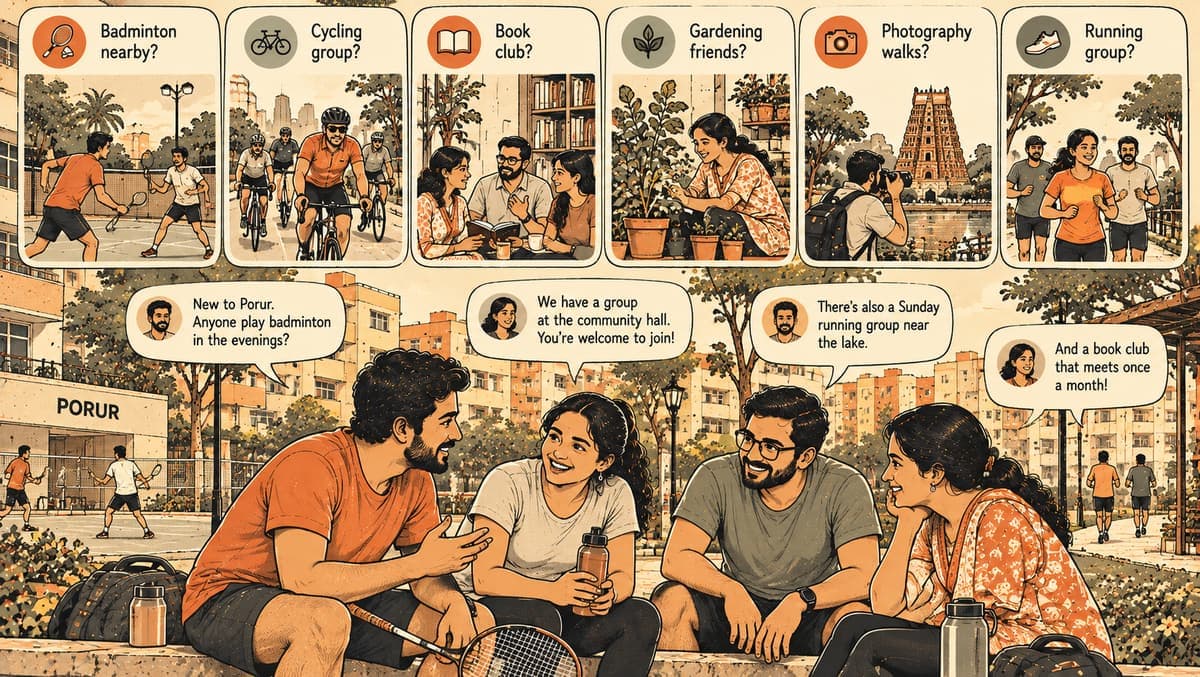

- Friends nearby help in practical ways, from holding a spare key to covering the school run at short notice.
- Being known on your street makes a place feel like home in a way distant friendships cannot.
- Adult friendships need intention, so join a circle, go to a nearby event and keep in touch afterwards.
Most of us have friends spread across the city. A college friend in Tambaram, an old colleague near Nungambakkam, a cousin who moved to the other end of OMR. We love them, and we see them twice a year if the traffic allows.
Local friends are a different thing. They are the people you can reach in five minutes on foot. The ones who notice your car hasn't moved in three days, who can take in a parcel, who will walk with you to the corner shop when the streetlights are out.
Making them as an adult is harder than it was at school, when friendship came with a shared bench. But it is far from impossible, and the payoff shows up in both the practical and the quieter parts of life.
Why local friends are a category of their own
A friend across the city shares your history. A friend down the road shares your present: the same rain, the same broken pavement, the same water tanker that comes late on Tuesdays.
That shared present is what makes local friendship useful. You don't need to explain where things are or what the problem is. When the Velachery main road floods, your neighbour already knows which side lane stays dry. When the school changes its pick-up gate, the parent two floors down heard about it first.
It also makes the friendship easier to keep up. You don't need to plan a dinner three weeks out. You bump into each other at the vegetable vendor, on the terrace, at the temple during a festival. Small, frequent contact does the work that long phone calls do for distant friends.
The practical side: help within walking distance
The everyday benefits of having friends nearby are easy to overlook until you need them:
- A spare key holder. Locked out after a late shift? A friend three doors away is better than a locksmith at midnight.
- Borrowing instead of buying. A ladder for the fan, a drill for one shelf, a pressure cooker gasket in a pinch.
- Backup for the school run. If your meeting runs late, someone who already walks that way can bring your child home.
- Honest recommendations. Which tailor actually finishes on time, which tuition teacher is patient, which electrician turns up when he says he will.
- An extra pair of eyes. Someone who notices the gate left open or water leaking from your balcony while you are away at a wedding.
None of this is dramatic. It's the steady background help that makes a busy week manageable.
The quieter side: feeling at home
There is a second benefit that's harder to list. Living near people who know you changes how a place feels.
A street where someone waves at you is not the same as a street where nobody looks up. A long Sunday is easier when you know you could drop in for a cup of filter coffee. Festivals feel fuller when there is a neighbour to share sweets with at Diwali or to admire the kolam with during Margazhi.
Many people describe this as a sense of belonging: you are part of the place, not just passing through it. It doesn't need big gestures. It grows from being recognised, greeted and included, again and again. If you have been feeling the absence of this, our piece on feeling lonely in a big city has gentle first steps.
How to make local friends as an adult
Adult friendships rarely happen by accident. They need a little intention. Here is an approach that works for most people:
- Pick a routine and repeat it. Walk at the same time, use the same park, sit at the same tea stall. Familiar faces become hellos, and hellos become conversations.
- Ask small questions. "Do you know a good AC service person?" is an easy opener. People like being useful, and it gives them a reason to talk to you again.
- Offer something small back. Share a mango from your tree, pass on a book, mention a good shop you found. Friendship grows when help runs both ways.
- Join something with a shared purpose. A residents' clean-up, a readers' club, a cycling group. Doing something together is easier than chatting from scratch. Our guide to finding people who share your hobbies covers this in detail.
- Say yes to the second invite. The first time someone asks you over, you might be busy. Make sure the second time you go.
- Follow up. If you met someone at an event, send a note the next day. Most budding friendships fade simply because nobody makes the second move.
Don't aim for ten friends at once. One or two people you can genuinely call on is a strong start.
Where Zinola fits
Zinola is a free neighbourhood app and website for Chennai, built around the people who live near you. A few parts of it help with exactly the steps above:
- Circles. Join or start a group for your apartment, your neighbourhood or an interest, like runners, riders or readers. Inside, everyone is in the General chat, and admins can add smaller groups for topics like Kids & parents or Pets. Browse them at circles.
- Events nearby. The "What's on" part of Home shows events around you: meetups, workshops, sports, festival get-togethers. You can mark Going, Maybe or Can't go, and ask the host a question first. See what's coming up on events.
- Asking and helping. The + menu lets you Ask a question, ask for help or Recommend someone. Answering a neighbour's question is one of the easiest ways to start a conversation.
- Following people. When you meet someone, follow them. One-to-one chats open between people who follow each other, so staying in touch takes one tap.
The app doesn't make friends for you. It gives you more chances to meet the people already living around you.
Keeping local friendships going
The hard part isn't meeting people. It's keeping up once life gets busy again.
A few habits help. Keep a short list in your head of three or four neighbours you want to stay close to, and check in with one of them each week, even if it's just a message about the rain. Show up to the small things: a housewarming, a kids' birthday on the terrace, a Pongal gathering in the parking area. Remember details, like a name, an exam, an operation, and ask about them later.
And when a friend asks for help, say yes when you can. That is usually how a nodding acquaintance turns into the person you call first. For more on how gatherings move this along, read how local events turn neighbours into friends.
Questions people ask
- What are the benefits of having friends nearby?
- Local friends can help with everyday things like holding a spare key, covering a school pick-up or recommending a good tailor. Being known on your street also makes a place feel like home.
- How do adults make new friends in their neighbourhood?
- Repeat a routine so you see the same faces, ask small questions, offer small help back and join something with a shared purpose, like a club or a clean-up. Then follow up after you meet someone.
- Is Zinola free to use for meeting neighbours?
- Yes. Zinola is free for residents on Android, iPhone and the web, with no paid plans and no ads.
- Can I message someone I meet on Zinola?
- Yes, once you follow each other. One-to-one chats on Zinola only open between people who follow each other.
Find people near you
Join a circle for your building, your area or a hobby, and see who lives around you.
Explore circles