- An illustrative story shows how wide, thin contact lists differ from the few people who really show up.
- Following a small number of nearby people, with chats only between mutual followers, keeps things personal.
- Real friends are the ones who help in small ways, like answering a question or joining a clean-up.
This is an illustrative story. The people in it are made up; everything Zinola does in it is real.
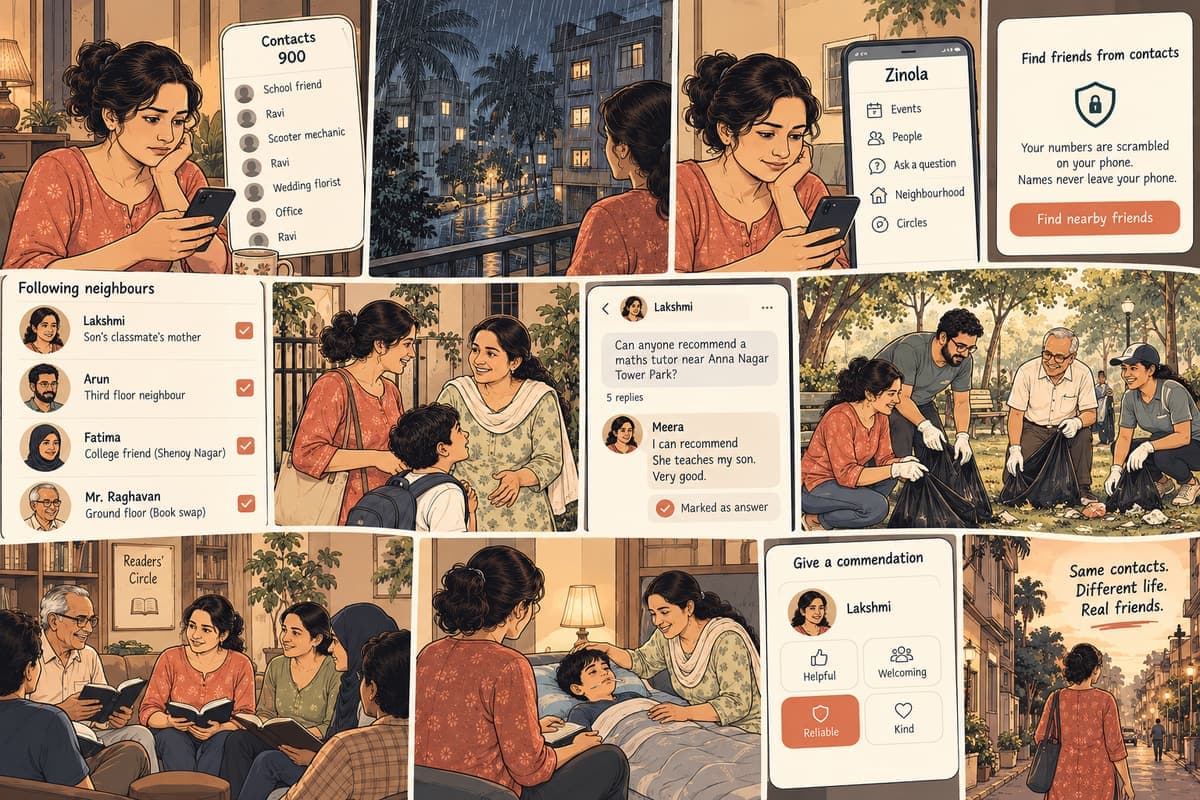
Meera had nine hundred contacts in her phone. Old classmates, the man who fixed her scooter once, a florist from a wedding years ago, three different numbers saved as "Ravi".
She lived in a flat in Anna Nagar with her husband and their seven-year-old, worked long hours, and would have said she had plenty of friends. Then one evening in November, with the rain coming down sideways and the power gone for the third time that week, she scrolled through all nine hundred names and realised she couldn't think of a single one she could ask to come over with a torch.
That was the evening she started paying attention to who her real friends were.
A phone full of contacts, and not many friends
Meera's problem wasn't that people didn't like her. It was that her connections were wide and thin. She "knew" a lot of people in the sense that they could see each other's status updates. Very few of them lived within walking distance, and fewer still would notice if she went quiet for a week.
A colleague had mentioned Zinola, a free neighbourhood app for Chennai. Meera installed it mostly to see the Alerts & timings board her apartment circle had set up for power and water cuts. But the People section caught her eye too.
When she tapped to find friends from her contacts, she hesitated. She did not want her whole address book uploaded somewhere. Then she read how it works: the numbers are scrambled on the phone itself, and names never leave the phone. That was enough for her to try.
Choosing who to follow
The list that came back was short. Out of nine hundred contacts, only a handful were on Zinola and nearby. Meera noticed that this felt like a relief rather than a disappointment.
She followed four people:
- Lakshmi, the mother of her son's classmate, who lived two streets away.
- Arun, a neighbour from the third floor she had chatted with at the lift a few times.
- Fatima, an old college friend she hadn't realised had moved to Shenoy Nagar.
- Mr. Raghavan, the retired teacher from the ground floor who ran the building's book swap.
She also switched her own account to private. Now anyone who wanted to follow her had to send a request, and she could approve the people she actually knew. It was a small setting, but it changed how the app felt: less like a stage, more like a front door.
Chats only with people who follow back
The first thing Meera wanted to do was message Fatima. She found she could, because Fatima had followed her back. On Zinola, one-to-one chats only open between two people who follow each other.
At first this seemed like a limitation. Then she thought about it the other way round. Nobody she didn't know could slide into her messages. Every name in her People chats was someone who had chosen her as much as she had chosen them.
Within a month, her chat list held six names. Her messaging app elsewhere held hundreds of threads. She knew which one told her more about her real friendships.
The people who showed up
Over the next few weeks, small things happened.
Lakshmi used "Ask a question" in the Neighbourhood feed to ask if anyone could recommend a maths tutor near Anna Nagar Tower Park. Meera replied with the name of the woman who taught her own son. Three other neighbours tapped "Me too" on the question, and Lakshmi later marked Meera's reply as the answer that sorted it.
Arun created an event for a Sunday morning clean-up of the park opposite their building. Meera tapped Maybe, then changed it to Going when she saw Mr. Raghavan was coming. They spent two hours picking up plastic, and afterwards Arun's wife brought sundal for everyone.
Mr. Raghavan invited Meera to the readers' circle he had started, an interest club with a General chat and a small group just for Tamil novels. The circle was closed, so only members could see the conversations.
And in December, when Meera's son had a fever and she was stuck in a meeting on OMR, it was Lakshmi who picked him up from school. Meera had asked one person. That person said yes.
What Zinola actually did in this story
Looking back, Zinola didn't create any of these friendships. The people were already there. What the app did was make them easier to see and easier to reach:
| What Meera needed | What she used |
|---|---|
| Find people she knew nearby without sharing her contacts | Find friends from contacts, with numbers scrambled on the phone |
| Decide who sees her updates | A private account, approving each follower |
| Talk one to one without strangers messaging her | Chats that open only between people who follow each other |
| Meet neighbours in person | Events with Going / Maybe / Can't go |
| A group around a shared interest | A closed interest-club circle |
| Thank someone in a way others can see | Commendations |
That last one mattered to Meera more than she expected. After the school pick-up, she gave Lakshmi a commendation for being Reliable. Zinola doesn't let people rate each other with stars, only give commendations: Helpful, Welcoming, Reliable or Kind. It felt like the right size for a thank-you between neighbours.
What Meera noticed
Real friends, Meera decided, were not the people who had her number. They were the ones who showed up in small ways: answered a question, came to a clean-up, took a sick child home without making a fuss.
She still has nine hundred contacts. She just knows now which few of them live in her real life.
If Meera's story sounds familiar, you might like why neighbourhood friendships matter more than follower counts, or our piece on building trust with neighbours. You can also see what's happening near you on events.
Questions people ask
- Does Zinola upload my phone contacts?
- When you find friends from contacts, the numbers are scrambled on your phone, and names never leave the phone.
- Can strangers message me on Zinola?
- No. One-to-one chats only open between people who follow each other, and group chats live inside circles.
- Can I choose who follows me?
- Yes. If you make your account private, people have to request to follow you and you approve them.
- Can I rate a person on Zinola?
- No. People can't be rated, but they can get commendations: Helpful, Welcoming, Reliable or Kind.
See who lives near you
Find people you already know nearby, follow them and keep in touch on Zinola, free.
Find people