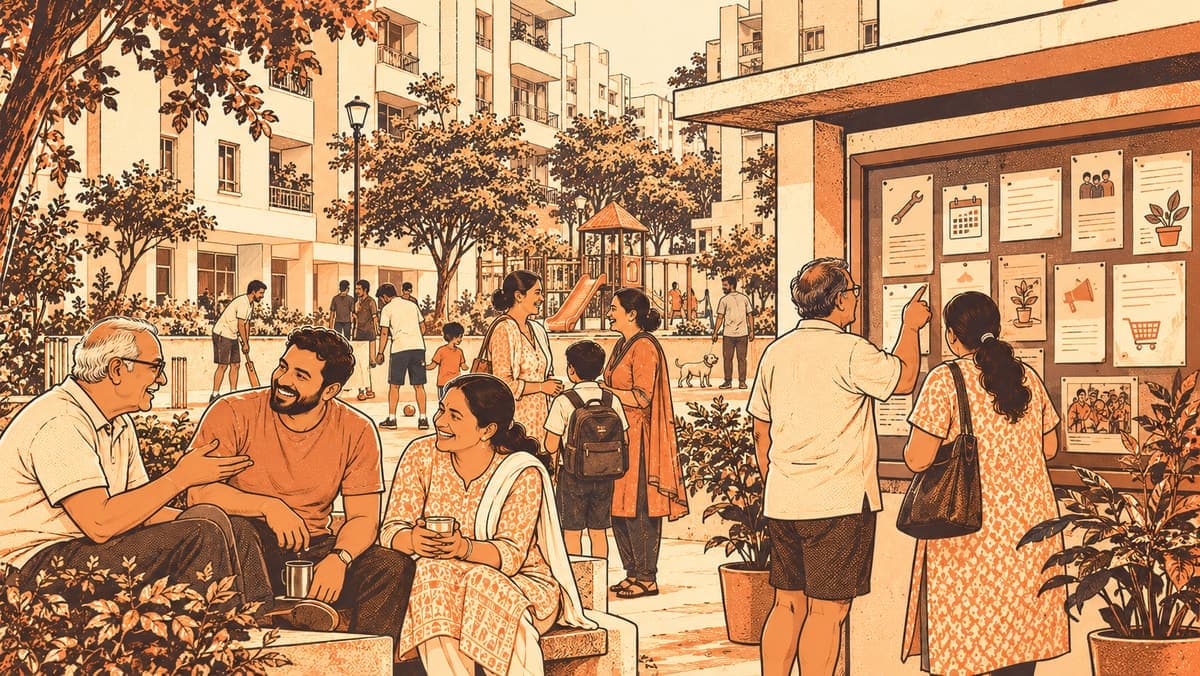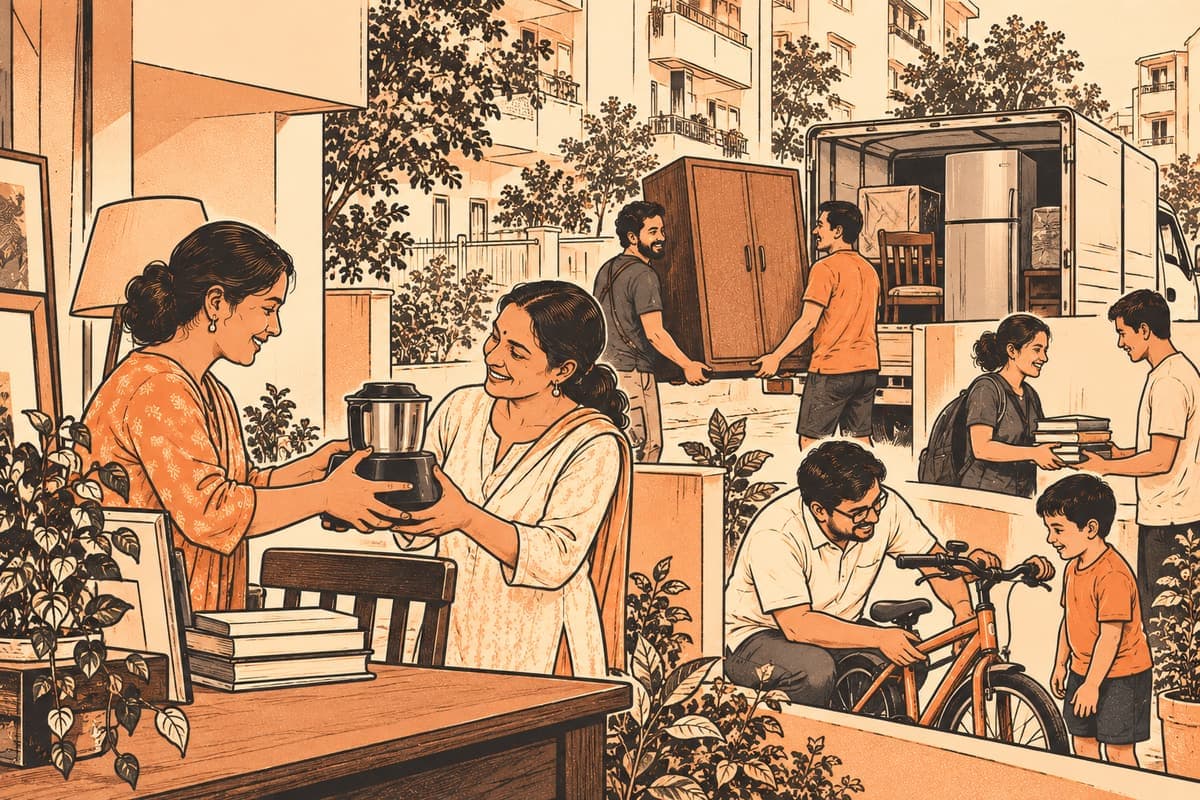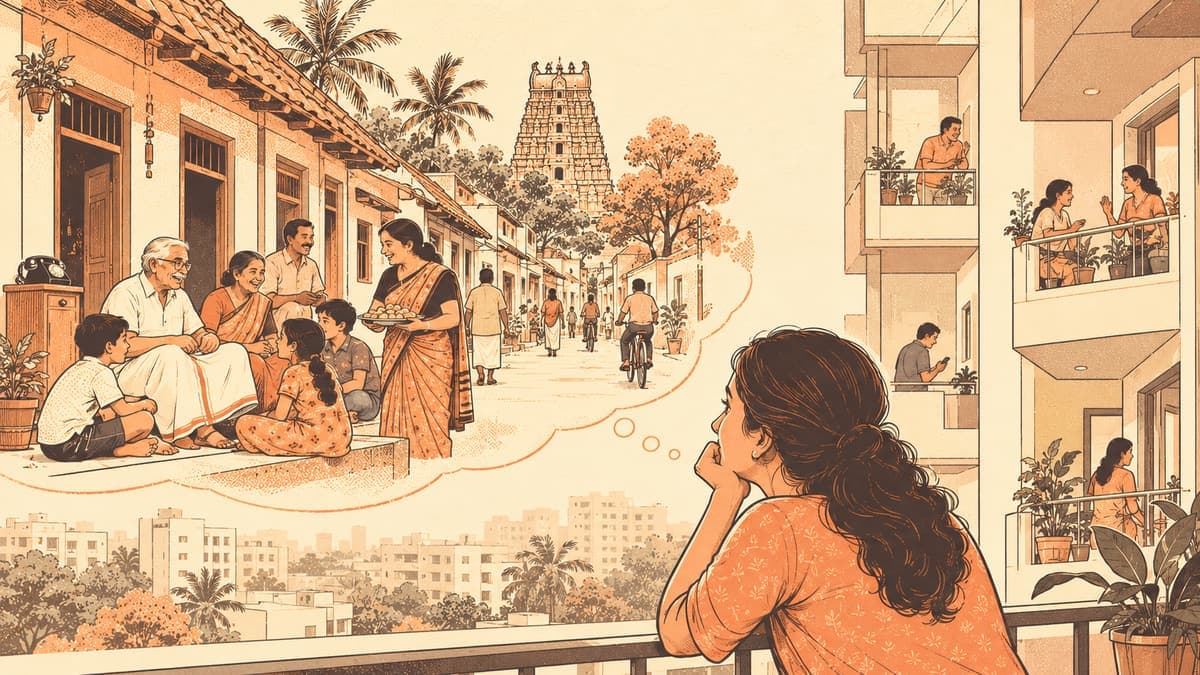
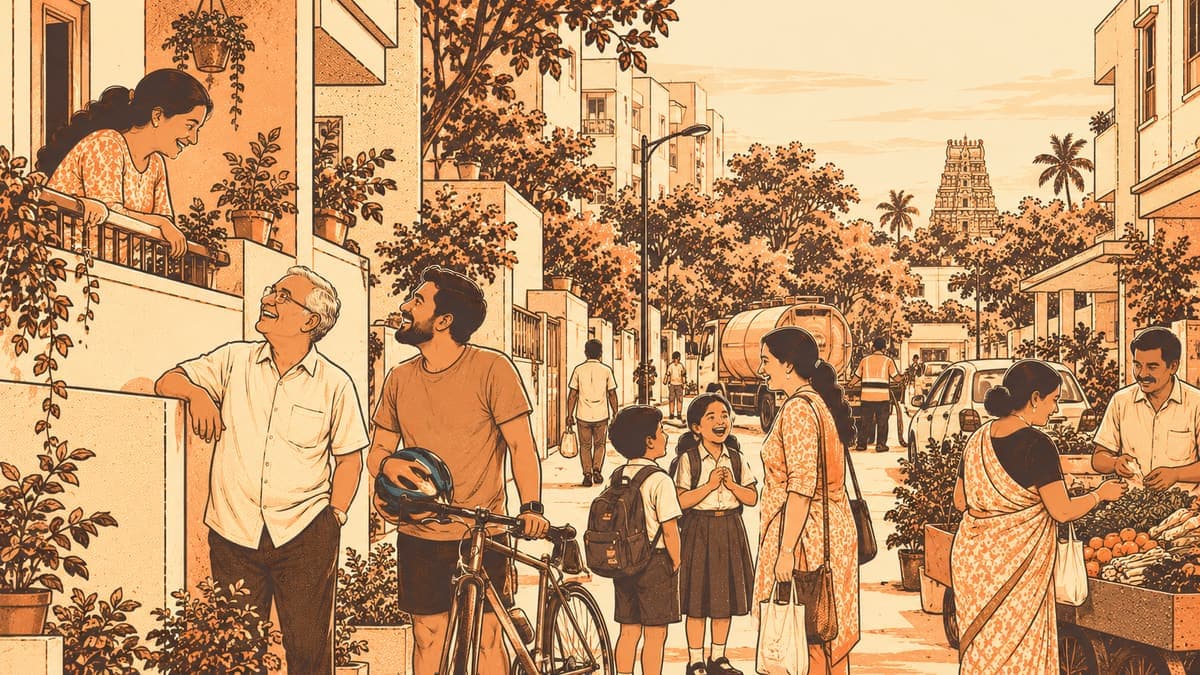
- A neighbourhood is a safety net on bad days and a shared rhythm of daily timings.
- It is also a local economy of services, home businesses and second-hand goods within a few kilometres.
- Being known by name brings belonging, and small habits over a month help you live in your area.
Ask someone in India where they live and you'll usually get an answer with a landmark attached. "Viman Nagar, near the airport." "Ballygunge, behind the hospital." "Indiranagar, just off 100 Feet Road." We describe our homes by what is around them. That says something: a neighbourhood is not just an address. It is the thing that surrounds the address and makes it liveable.
Yet many of us treat our area like a hotel. We sleep there, we leave early for the long commute, we come back late, we close the gate. The flat could be anywhere. And then something happens — a heavy monsoon night, a sudden fever at 2 am, a child who needs a lift to an exam centre — and we realise how much we depend on the people around us, and how little we have invested in knowing them.
This article looks at what a neighbourhood actually gives you beyond four walls, and how to start receiving (and giving) more of it.
A neighbourhood is a safety net
The clearest value of a neighbourhood shows up on bad days.
When the streets flood in the monsoon, the people who help first are the ones nearby: the neighbour with a generator who lets you charge your phone, the boys from the next street who check on elderly residents, the shop that stays open late with candles and bread. During long power cuts, someone always knows whether it is a local transformer fault or a planned shutdown.
This net only works if the threads exist before the bad day. A neighbour is far more likely to knock on your door in a crisis if you have said hello a few times before.
A simple test: if you had to leave a house key with someone on your street tonight, who would it be? If you cannot think of anyone, your safety net needs some work.
A neighbourhood is a rhythm
Life in an Indian neighbourhood runs on small, shared timings:
- The milk packet at 5:30 am.
- The corporation garbage van, which seems to follow its own calendar.
- The water tanker that arrives "around ten" — which can mean anything.
- The school van horn at 7:15.
- The temple's evening aarti that tells you it's past six.
Knowing these rhythms saves real time and stress. Newcomers spend weeks figuring them out. Long-time residents carry them in their heads. A neighbourhood becomes home when you are in step with its rhythm — and it becomes a community when that knowledge is shared openly instead of learnt the hard way.
A neighbourhood is an economy
Much of what keeps a household going comes from within a few kilometres:
- Services: the plumber who answers on a Sunday, the electrician who explains what went wrong, the AC mechanic before summer.
- Home businesses: the aunty who takes orders for snacks before Diwali, the student who gives guitar lessons, the woman who stitches blouses from her front room.
- Second-hand goods: a cot your child has outgrown, a cycle, a study table someone a street away needs right now.
When money and goods move within a neighbourhood, people get to know each other along the way. You don't just buy a cake; you meet the person who baked it. We explore this side further in why your neighbourhood could be the best place to buy and sell.
A neighbourhood is a source of belonging
Beyond the practical, there is the feeling of being known. Being greeted by name at the provision store. Children who can play in the park because parents know each other. Being invited to a housewarming two doors down, or to the street's Ganesh Chaturthi celebration.
Belonging does not happen automatically, even in a crowded city. It grows through small, repeated moments: a shared festival, a question answered, a lost dog returned. Places with many such moments feel warm. Places without them feel lonely, however crowded they are.
Where Zinola fits
Zinola is a free neighbourhood app and website. It is built to make each of the four roles above easier to fill:
| What a neighbourhood gives | How Zinola supports it |
|---|---|
| Safety net | "Need help" and "Ask a question" posts from the + menu reach people around you. Inside apartment or street circles, board tools include Alerts & timings and Important numbers. |
| Rhythm | Circles can post alerts and timings for power and water cuts, the tanker, garbage and milk, so the rhythm is written down, not guessed. |
| Economy | The marketplace lets neighbours sell, give away, lend or ask for things, with nearest listings first. Buyers chat privately with sellers; numbers stay hidden unless the seller chooses to share. You pay the seller directly — Zinola doesn't handle money. |
| Belonging | Public events for your area appear under "What's on", with Going / Maybe / Can't go. Six reactions, including Helpful and Me too, let people respond to each other's posts. |
It is free for residents and businesses, with no ads and no paid ranking. Community rules are public at /rules, and reported content is hidden and reviewed by the team.
How to start living in your neighbourhood, not just at it
You don't have to change your whole routine. Try a few of these over the next month:
- Swap one errand. Buy something from a local shop or home business instead of ordering it from far away.
- Answer one question. When someone nearby asks for a tutor or a carpenter, share who you use.
- Attend one local event. A temple festival, a park clean-up, a kids' art session — anything within walking distance.
- Give one thing away. That pressure cooker you replaced is someone else's useful find.
- Learn one rhythm. Find out when the tanker comes or when the next planned shutdown is, and tell your floor.
Each of these is small. Together, they turn a place you live into a place you belong. If you're curious about the bigger picture, read why your neighbourhood deserves its own digital community.
More than four walls
A flat in Andheri or a house in Lajpat Nagar is bricks and paint. What makes it a good place to live is everything outside the door: the people who would help, the rhythm you've learnt, the small businesses you trust, the festivals you share. That's your neighbourhood. It's worth investing in — and it gives back more than you'd expect.
Questions people ask
- How do I feel more connected to my neighbourhood?
- Start small: buy from a local shop, answer a neighbour's question, attend one event nearby, and share practical timings like when the tanker comes.
- Can my apartment share power and water cut timings on Zinola?
- Yes. Circles have an Alerts & timings board for power and water cuts, the tanker, garbage and milk, plus a list of Important numbers.
- Does Zinola handle payments when I buy from a neighbour?
- No. You pay the seller directly, and Zinola doesn't handle money.
- What happens if someone posts something abusive?
- You can block and report. Reported content is hidden after reports and reviewed by the team, and the community rules are public at /rules.
Bring your street together
Start a circle for your apartment or street, with group chats, alerts and important numbers in one place.
Explore circles