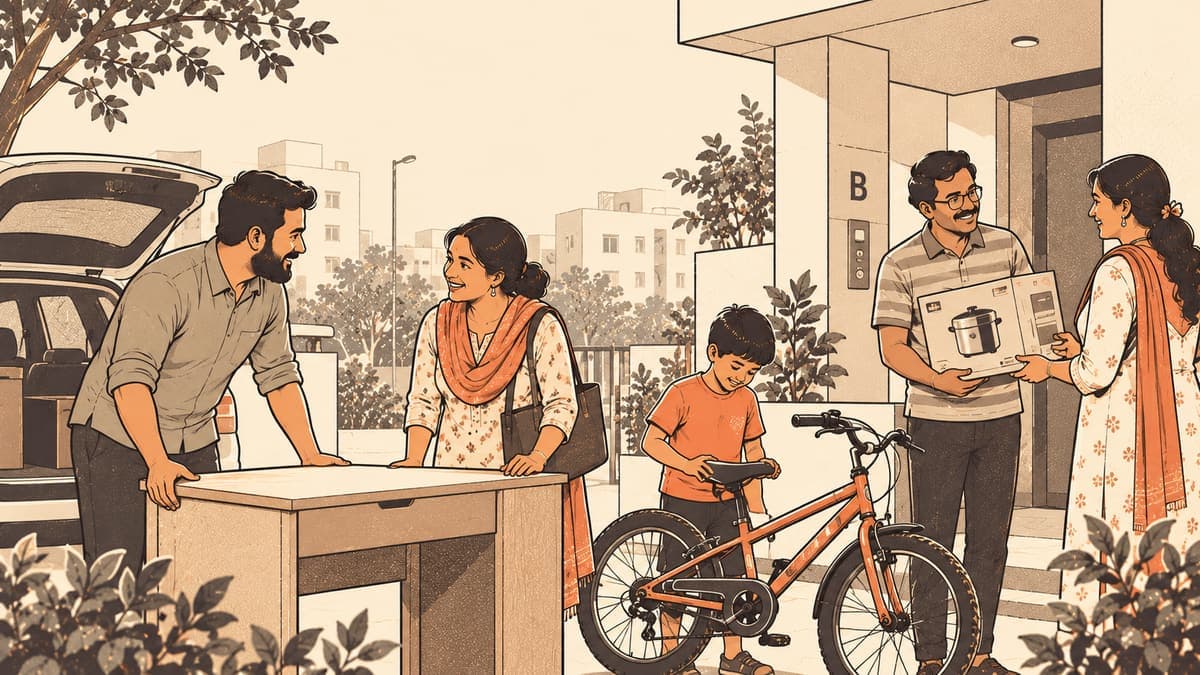
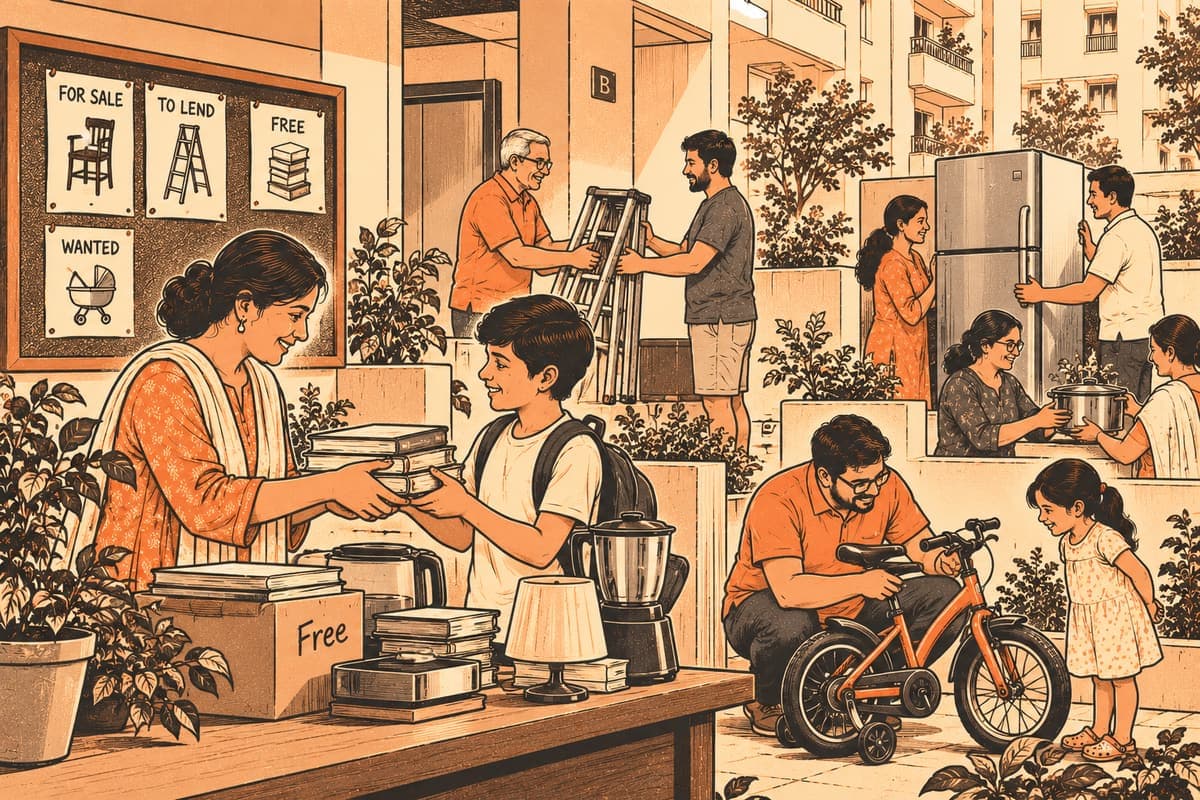
- Classifieds connect strangers across the city, but neighbours also lend, give, ask and trade in groups.
- Apartments benefit from keeping some sales inside the building, among people they already know.
- Writing down simple etiquette for buying and selling with neighbours keeps local trade friendly.
Online classifieds have been around in India for a long time, and they solved a real problem. Instead of an advert in the Sunday paper, you could post your old scooter or a spare washing machine online and reach buyers across the city. For many kinds of sale, that still works well.
But think about the last few things that changed hands in your apartment. A neighbour lent you a step ladder to clean the ceiling fans before Diwali. Someone in Block C gave away their son's old school books. The association organised a group order for mosquito nets before the rains. A resident asked whether anyone had a spare wheelchair for her father for a fortnight.
None of those were classified adverts. They were neighbours helping neighbours, with a bit of buying and selling mixed in. A classifieds platform is a notice board. A neighbourhood needs a notice board, a lending shelf, a giveaway box and a conversation, all in one place.
What a classifieds platform is built to do
A classifieds platform is good at one job: connecting a seller with a buyer, often a stranger, often in another part of the city. It's organised around categories and adverts. That's its strength.
What it isn't really built for are the things that make a neighbourhood work:
- Lending and borrowing between people who will see each other again.
- Giving things away to someone who needs them, quickly and without fuss.
- Asking for something nobody has listed yet.
- Trading within a closed group, like your apartment or residents' association.
- Knowing who's who, so you can tell the resident in Flat 4B from a stranger.
These aren't criticisms. They're simply different jobs.
What a neighbourhood actually needs
If you sat down with your RWA committee in Powai, Mumbai, or Dwarka, Delhi, and listed what residents exchange in a year, it might look something like this:
| Kind of exchange | Typical example |
|---|---|
| Selling | A used fridge, a kid's cycle, a dining set |
| Giving away | Old textbooks, moving boxes, leftover tiles |
| Lending | A drill, a ladder, a wheelchair, a big biryani vessel |
| Wanted | "Anyone have a spare baby cot for two months?" |
| Group buying | Mosquito nets, festival flowers, a bulk order of rice |
| Small business | Homemade snacks, tuition, alterations |
Only the first row is what classifieds are made for. The rest need trust, nearness and a way for residents to talk to each other.
Keeping it inside the community
One of the most useful things for an apartment is the option to keep a sale inside the building.
Say a family in a gated community in Kondapur, Hyderabad, is moving abroad and selling almost everything. They may not want their flat number and furniture shown to the whole city. They'd rather offer it to the other residents first, let people drop by over a weekend, and only then go wider.
The same goes for lending. You'll happily lend your pressure washer to the family on the second floor. You probably won't post it for strangers.
Keeping things in the building also helps with festivals and seasons. Before Durga Puja, one resident has a spare brass lamp, another has extra fairy lights from last year, and a third wants both. Before the monsoon, someone is selling a raincoat their son outgrew while a new family down the corridor needs exactly that size. These small matches happen easily when the whole building can see the same list, and they rarely happen when each item is lost among adverts from across the city.
Etiquette for buying and selling with neighbours
Living close also means a few unwritten rules. Many associations find it helps to write them down:
- Be honest about faults. You'll see the buyer in the lift tomorrow.
- Return borrowed things on time, and clean.
- Don't haggle too hard over a ₹200 item from the family upstairs.
- Hand over in common areas such as the lobby or the security cabin, not deep inside someone's flat, unless both sides are comfortable.
- Keep commercial posts in the right place, so the main group stays useful.
- Mark things sold so nobody knocks on your door for something that's gone.
Where Zinola fits
Zinola is a free neighbourhood app, made for exactly this mix of selling, giving, lending and asking.
Circles are groups for your apartment or RWA, neighbourhood, school, workplace or interest club. Every circle gets an automatic "Buy & sell" room, and residents can start a sale or a group buy straight from chat. Circles can be open, closed to members or invite-only.
The marketplace has listing types for real neighbourhood life: For sale, Free, Wanted and To lend, alongside Offer, Showcase, Free slots, Stock and goods and Announcement. There is no rent type; a To lend listing tracks whether the item is lent or returned. A seller can show a listing only to their circles, to chosen areas, or more widely, and nearby buyers see the nearest listings first.
Privacy is built in. Buyers tap "Ask about it" for a private chat, numbers stay hidden unless someone chooses to share theirs, and phone numbers are never shown on posts. Anyone can block or report, and the community rules apply to everyone.
Zinola doesn't handle money, doesn't deliver and can't step in if a deal goes wrong. You pay the seller directly and arrange the handover between you.
If you manage an RWA and want to set one up, the guide to starting a circle for RWAs and apartments explains the steps. For more on running a lively residential community, read how to build a more active and connected apartment community, and for the wider argument for trading close to home, see buy and sell within your neighbourhood.
Questions people ask
- Can our apartment have its own buy and sell space on Zinola?
- Yes. Every circle, including apartment and RWA circles, gets an automatic "Buy & sell" room, and residents can start a sale or group buy from chat.
- Can I list something only for people in my apartment?
- Yes. When you post on the marketplace you can show a listing only to your circles, or to chosen areas, a city, a state or all of India.
- Is there a way to lend things instead of selling them?
- Yes. Use the To lend listing type, which tracks whether an item is lent or returned. Zinola has no rent listing type.
- Are phone numbers shown on Zinola listings?
- No. Buyers start a private chat with "Ask about it", and numbers stay hidden unless someone chooses to share theirs.
Give your apartment its own market
Start a circle for your building or RWA and get a ready-made Buy & sell room for residents. It's free.
Start a circle