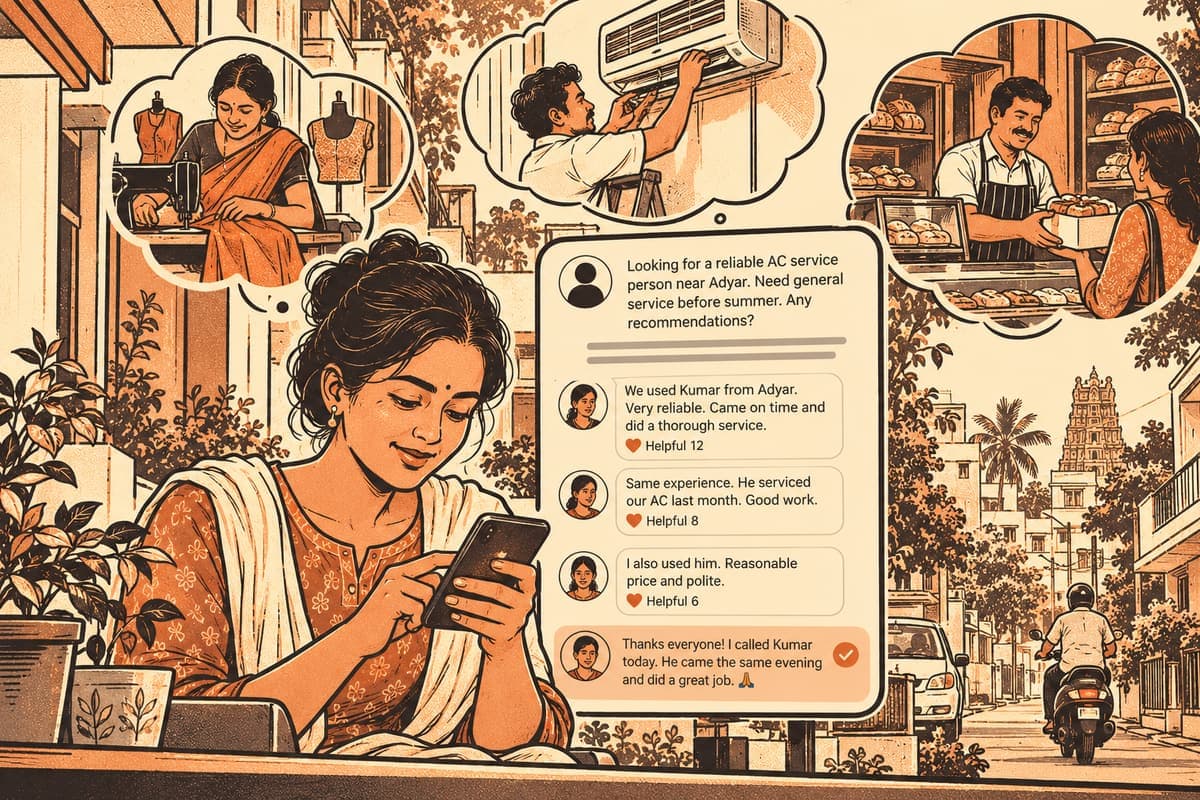
- A good question says exactly what you need, where you are, when, and what matters to you.
- Several neighbours independently saying the same name is a stronger signal than one keen reply.
- The asker closing the loop with what actually worked makes the thread useful for the next person.
Every neighbourhood in Chennai has the same kind of questions floating around. Which tailor near the Adyar signal finishes a blouse before a wedding? Does anyone know a reliable AC service person before the May heat arrives? Is the new bakery on the main road actually good, or just new?
The answers already exist. They sit in the heads of people who live two streets away. What usually goes missing is the path between the person asking and the person who knows. A question shouted into a busy group chat scrolls away in ten minutes. A question asked well, in the right place, can keep helping people for months.
This article walks through what happens to a question from the moment someone types it to the moment it becomes a useful answer, and what you can do at each step to make that journey shorter.
Step one: a question that can actually be answered
Most unanswered questions are not ignored. They are simply too vague to answer. "Need a good doctor" could mean a paediatrician, a dentist or someone who makes house visits for an elderly parent. Nobody wants to guess.
A question that gets answered usually has four things in it:
- What exactly you need. "A carpenter to fix two wardrobe hinges and a sagging shelf", not "a carpenter".
- Where you are. Your area, or at least the side of the city. A Tambaram answer does not help someone in Kilpauk.
- When. "This Saturday morning" or "before Deepavali" tells people whether their suggestion is even relevant.
- What matters to you. Budget, language, whether they come on time, whether they clean up after.
Compare these two:
| Vague | Answerable |
|---|---|
| Any good tuition in the area? | Looking for maths tuition for a Class 9 CBSE student near Anna Nagar West, weekday evenings after 6. Small batches preferred. |
| Need a plumber urgently | Kitchen sink leaking under the counter in Velachery, need someone today or tomorrow. Happy to pay a visiting charge. |
The second version takes thirty seconds longer to write and saves a day of back-and-forth.
Step two: replies arrive, and they are not all equal
Once a question is out, replies come in different shapes. Some people share a name and a story: "We used him for our bathroom last monsoon, he came back for free when the joint leaked again." Some people add a quick "same question, following". Some people share something only half related.
All of these have value, but a person reading the thread later needs to find the best answer fast. In a plain chat, that means reading every message in order. In a community built around questions, the replies can be sorted by how useful the neighbourhood found them.
That is the quiet work that turns a pile of replies into an answer: people who read the thread signal which reply helped them, and the best ones move up.
Step three: the neighbourhood agrees
The strongest signal for a good answer is not one enthusiastic reply. It is several people independently saying "yes, this one worked for us too".
When three different families in the same Mylapore lane have used the same electrician and say so, a newcomer can trust that more than any single glowing message. Agreement from people who have nothing to gain is what makes local knowledge reliable.
This is also why it helps to react even when you have nothing new to add. If a reply already says what you would have said, backing it up is more useful than repeating it.
Step four: the asker closes the loop
The person who asked is the only one who knows what actually solved their problem. When they come back and say "I called the second number, he came the same evening, fixed it for a fair price", the thread changes from a discussion into a record.
Closing the loop does three things:
- It thanks the person who helped, in public.
- It tells everyone with the same problem later which answer to try first.
- It stops people from replying to a question that is already sorted.
If you ask a question, make a habit of returning to it. Even "none of these worked, I found someone through my office instead" is useful information.
Where Zinola fits
Zinola is a free neighbourhood app and website for Chennai, and its Home feed is built around this exact journey. From the + menu you can choose Ask a question or Need help, so your post is clearly marked as something that wants an answer.
Neighbours reply, and they can react with one of six reactions: Helpful, Happy, Me too, Bad, Sad and Trash. Answers neighbours agree with rise to the top, so the reply most people backed up is the one a later reader sees first. You can read more about this on our how ranking works page. Nobody pays to rank.
When you have your answer, you can mark the one that sorted it. That mark stays on the thread, so the next person looking for an AC technician in your area finds a settled answer rather than an open argument.
A few other things help the journey along:
- You can @-tag a neighbour or a business in a reply, so the person who knows gets pulled into the conversation.
- If you live in an apartment or belong to a residents' group, you can also ask inside your circle, where only members see it.
- Phone numbers are never shown on posts, so nobody has to publish their contact details just to help.
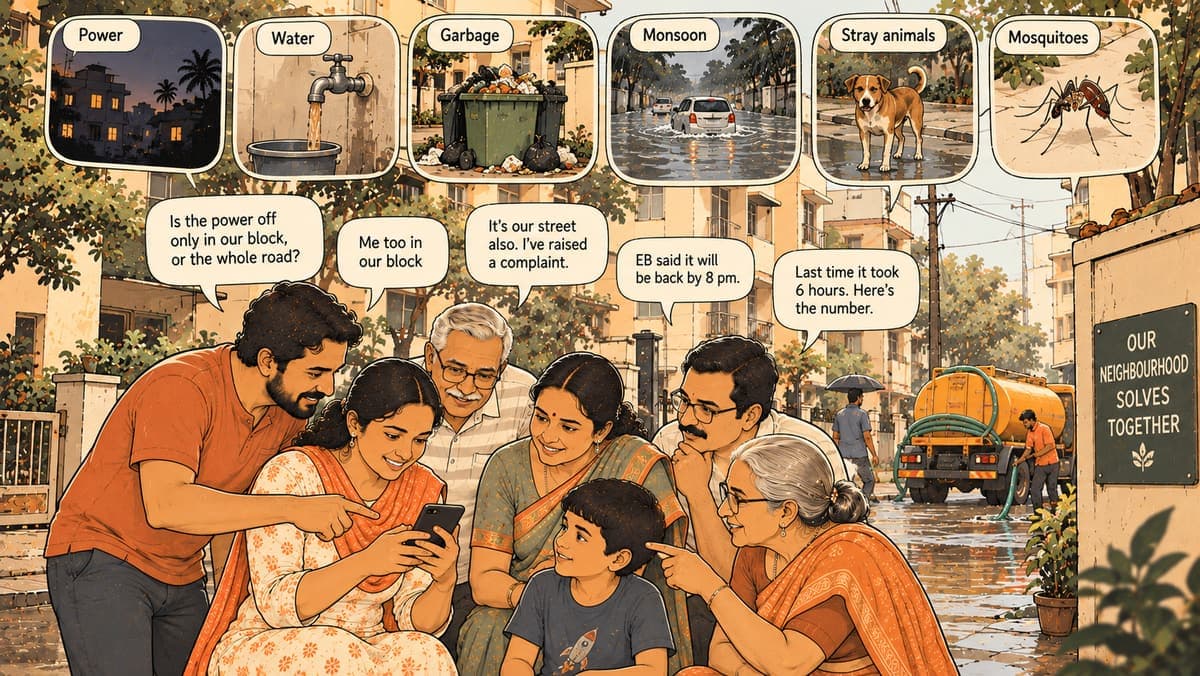
If you want to understand how questions in one lane end up helping the whole area, one neighbour's question can help an entire community goes deeper into that idea.
Small habits that make answers better for everyone
The quality of local answers depends on the habits of the people giving them. A few that make a real difference:
- Say when you used them. "Last month" and "four years ago" are very different recommendations.
- Say what the job was. A painter who did a beautiful single room may not be the right person for a full flat in a hurry.
- Mention the not-so-good parts too. "Excellent work but came an hour late both days" is more useful than pure praise.
- Keep private details out. Do not post someone's phone number, your door number or your children's school in a public reply. Point people to a business page or a private chat instead.
- Do not answer just to answer. If you have not used the service yourself, say so, or let someone who has reply.
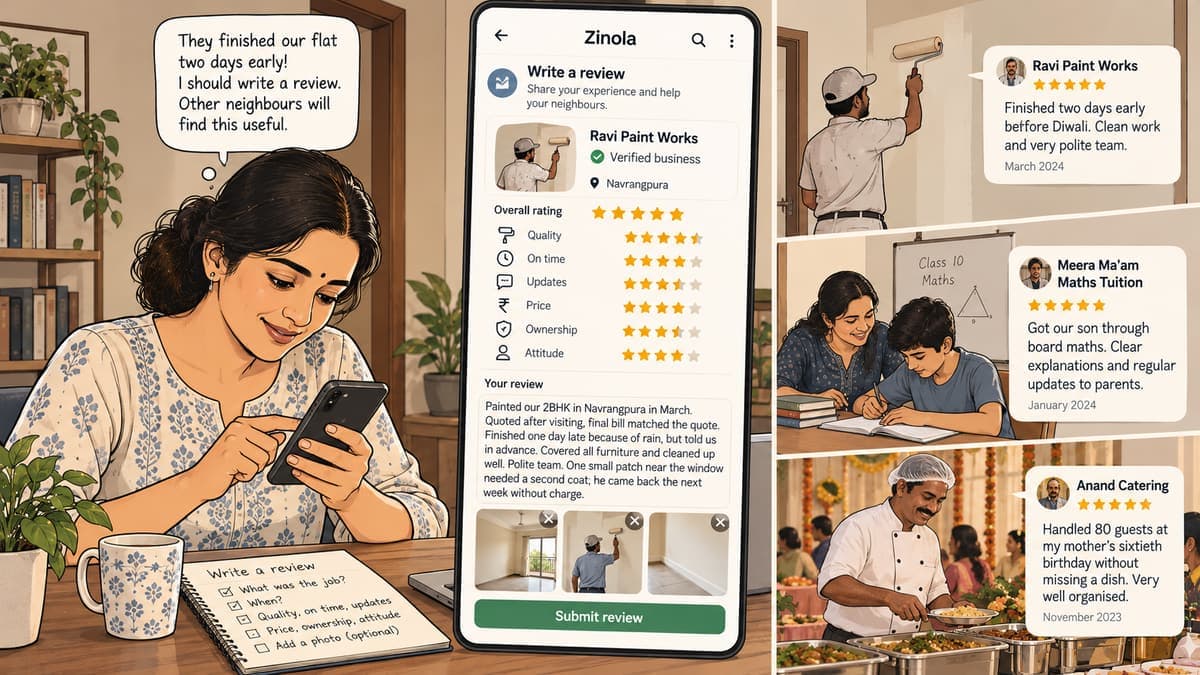
When you have more to say than fits in a reply, like a proper review of a business you have used, your experience could help someone in your neighbourhood explains how to write one that people actually find useful.
Questions are how a neighbourhood shares what it knows. Ask clearly, answer honestly, back up the replies that helped you, and close the loop when you are done. Do that, and every question asked on your street becomes a small piece of knowledge the whole area can use.
Questions people ask
- How do I ask my neighbours a question that actually gets answered?
- Say exactly what you need, which area you are in, when you need it and what matters to you, such as budget or timing. A specific question is far easier to answer than a vague one.
- How does Zinola decide which answer shows first?
- Answers neighbours agree with rise to the top, based on how people react to them. Nobody pays to rank.
- Can I mark the answer that solved my problem on Zinola?
- Yes. The person who asked can mark the answer that sorted it, so later readers with the same question can find it quickly.
- Is my phone number shown when I ask or answer a question?
- No. Phone numbers are never shown on posts on Zinola.
Ask your neighbourhood
Post a question on Zinola and let people nearby share what they know. It is free for everyone in Chennai.
Get the app