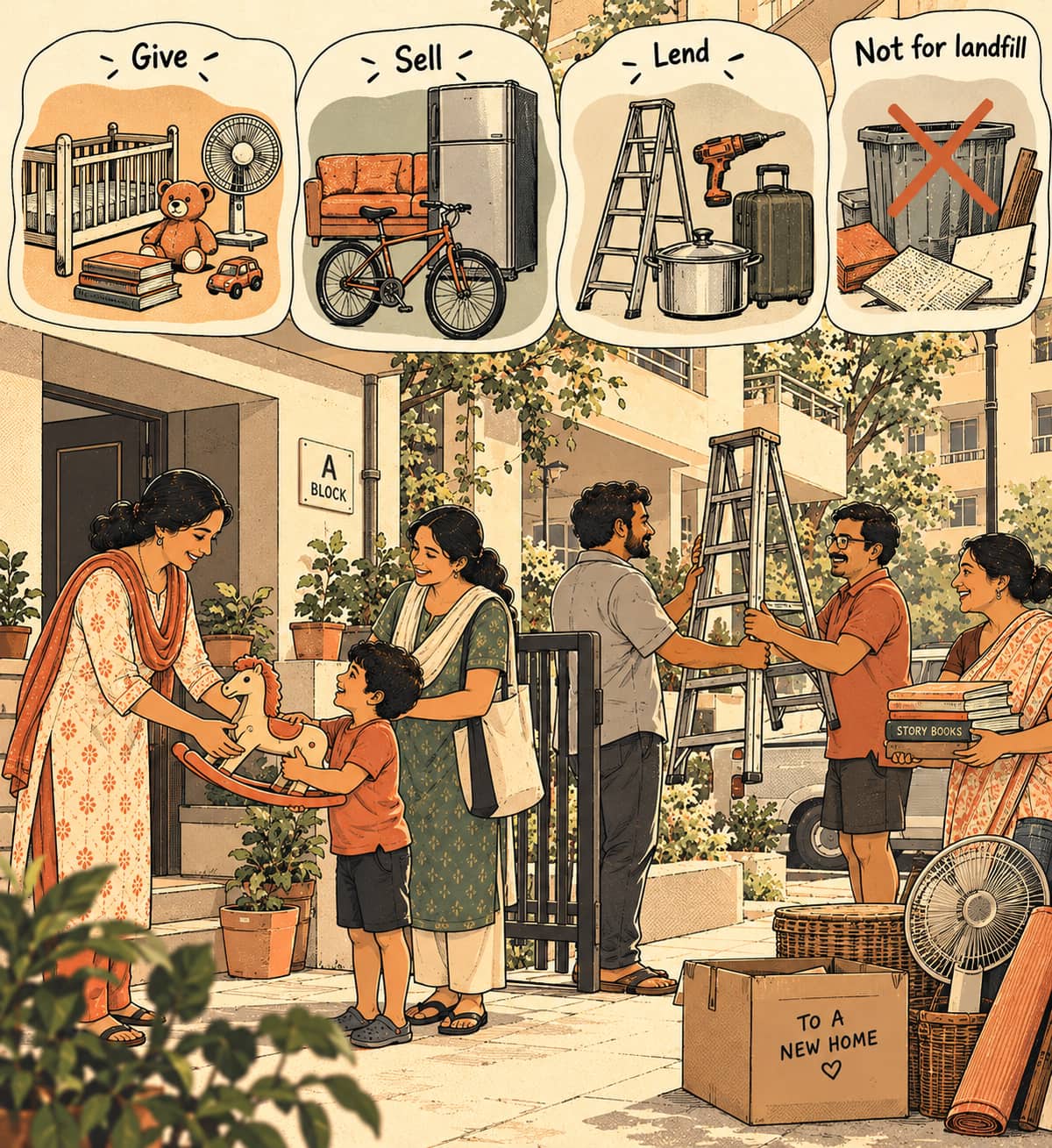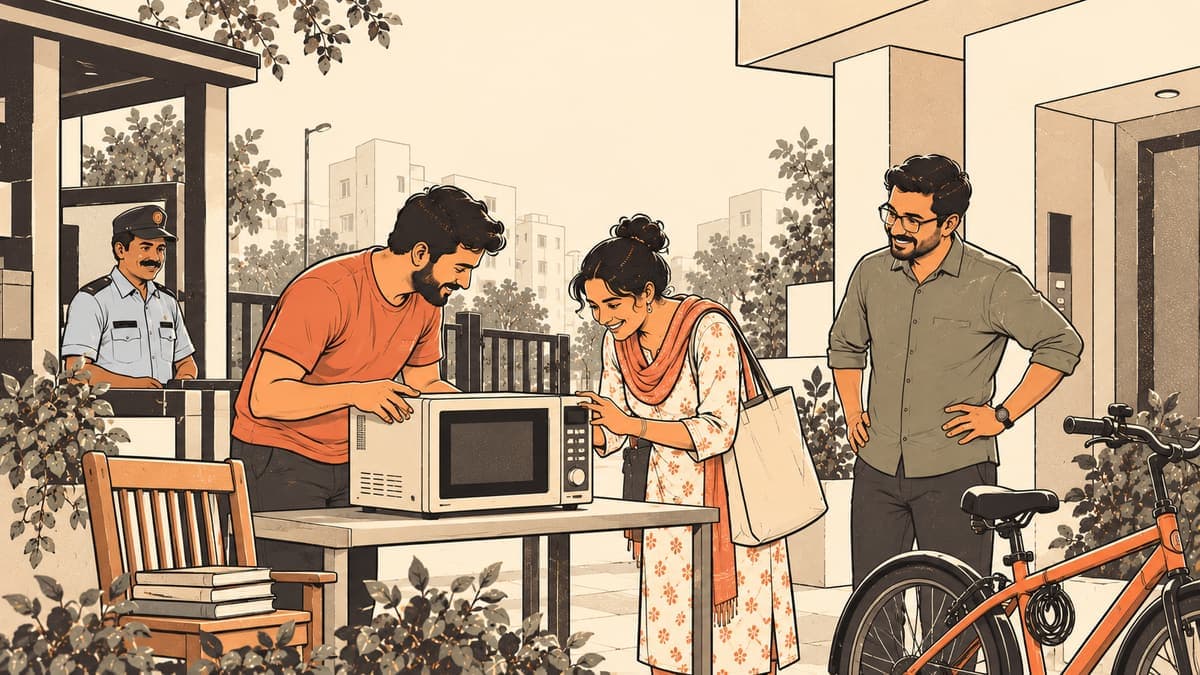

- Big items suit local selling because transport is short and buyers can see the real size.
- Price furniture and cycles on condition, age and how hard they are to move, not on what you paid.
- Agree in advance who arranges transport, floor and lift access, society rules and payment at handover.
Small things are easy to sell anywhere. A phone, a book or a pair of earphones can go into an envelope. Big things are different. A three-seater sofa, a teak wardrobe, a queen-size cot or a geared bicycle cannot be posted across the city without real cost and real effort.
That is exactly why bulky, heavy items are where local buying and selling makes the most sense. When the buyer is ten minutes away in the same part of Andheri, moving a sofa means one small tempo and two people, not a full-day exercise.
This article focuses on the big stuff: furniture, bicycles and large appliances. How to price them, how to show them, and how to get them from one home to another without a scratched lift or a strained back.
Why big items belong in the local market
Think about what it takes to move a wardrobe across Delhi, from Lajpat Nagar to Rohini. You need a mini truck, a loader or two, time off on a weekday and patience for the traffic on the Ring Road. That cost often eats up whatever you saved by buying second-hand.
Close by, the picture flips:
- Transport is cheap and short. A tricycle cart, a small goods auto, or a car with the back seats folded is often enough.
- The buyer can see the real size. No surprises when a dining table turns out to be too wide for the hall.
- You can sell in pieces. A neighbour might want only the dining chairs, another only the table.
- Families moving in and out create steady demand. Cities like Hyderabad see a lot of movement, especially among people working in the Gachibowli offices and families shifting at the start of the school year.
Pricing furniture and cycles fairly
Pricing is where most big-item sales go wrong. Sellers remember what they paid. Buyers compare with new prices. A fair middle comes from condition, age and how easy the item is to move.
| Condition | What it looks like | Pricing approach |
|---|---|---|
| Like new | Under a year old, no marks, original parts | Close to half of the current new price is usually reasonable |
| Good | A few years old, light scratches, works fully | Somewhere between a third and a half of new |
| Used | Visible wear, small repairs needed | Well under a third of new; price to move |
| Needs work | Broken parts, termite or water damage | Consider giving it away free to someone handy |
A few adjustments on top of that:
- Solid wood holds value better than particle board, which swells after a wet monsoon.
- Heavy and hard-to-move items need a lower price, because the buyer pays for transport.
- Branded, well-kept bicycles with recent servicing hold value well, especially geared ones.
- Seasonal timing helps. Cycles sell faster before the summer holidays; study tables before school reopens.
Always leave a little room for an offer. Most buyers in India will ask for something off, and it feels good on both sides to agree in the middle.
Showing big items properly
Photos of large furniture are often taken in dark rooms at odd angles. A few minutes of effort makes a big difference:
- Shoot in daylight, with curtains open, from a slight distance so the whole piece is visible.
- Include something for scale, like a door frame or a standard chair beside it.
- Write the exact measurements (height, width, depth) in the description.
- Show the flaws. A close-up of the scratch on the wardrobe door builds more trust than hiding it.
- Say whether it comes apart. Cots and wardrobes that can be dismantled are far easier to move.
For bicycles, add a few specifics: frame size, wheel size, whether the gears shift cleanly, the age of the tyres, and any rust. Homes close to the sea, in cities like Mumbai or Kochi, see more rust on chains and spokes, so photos of these parts help.
Planning the move from one home to the next
The handover is where big-item deals sometimes fall apart. Agree on these things in advance:
- Who arranges transport? Usually the buyer, but say it clearly.
- Which floor and is there a lift? A fourth-floor walk-up changes everything for a sofa.
- Lift or society rules. Many apartment complexes allow furniture moves only at certain hours or ask you to inform the security desk first.
- Help with lifting. Will the seller's household help, or does the buyer bring people?
- Payment at handover. The buyer pays the seller directly once they have checked the item, before it leaves the building.
If something is too awkward for anyone to collect, giving it away free to a carpenter or a neighbour with a truck is often the kindest outcome. Our post on giving pre-loved items a new home covers that side.
Where Zinola fits
Zinola's marketplace has categories for Furniture, Electronics & appliances, Pre-loved items and Kids & baby, which covers most bulky things people sell at home. Because listings are shown nearest first, a sofa in Kothrud reaches people in and around Kothrud before anyone on the far side of Pune.
Some features help specifically with big items:
- Mark a listing booked once someone has agreed to collect it, so other buyers know it is spoken for, and back to available if they drop out.
- Buyers can send offers, which keeps price talk in one clear place.
- Private chats through "Ask about it" let you agree floor, timing and lifting help without sharing your number, unless you choose to.
- Listings stay up for 30 days and renew in one tap, useful for slower-moving pieces like wardrobes.
Zinola does not arrange transport or take payment. Buyer and seller sort out the move and the money between themselves. For a walk-through of creating a listing, see our guide to selling to your neighbourhood.
Thinking a step beyond the sale
Furniture and cycles often lead to other needs. A second-hand cot might need a carpenter to tighten the joints. A cycle bought from a neighbour might need a new chain. Asking around locally works for these too, as our post on how local recommendations beat random online listings explains.
The best second-hand furniture in your city is rarely in a showroom. It is usually in a flat a few streets from yours, waiting for someone who has room for it.
Questions people ask
- How much should I ask for used furniture?
- It depends on condition, age, material and how hard it is to move. Like-new pieces often go for around half the new price, while worn pieces sell for much less.
- Does Zinola arrange transport for furniture?
- No. Zinola does not arrange pick-up or transport. The buyer and seller agree the move between themselves, usually with the buyer arranging it.
- Can I hold an item for one buyer?
- Yes. You can mark a listing as booked once someone agrees to collect it, and switch it back to available if they drop out.
List your big items locally
Furniture, cycles and appliances reach nearby buyers first, so the move stays short and simple.
Sell on Zinola