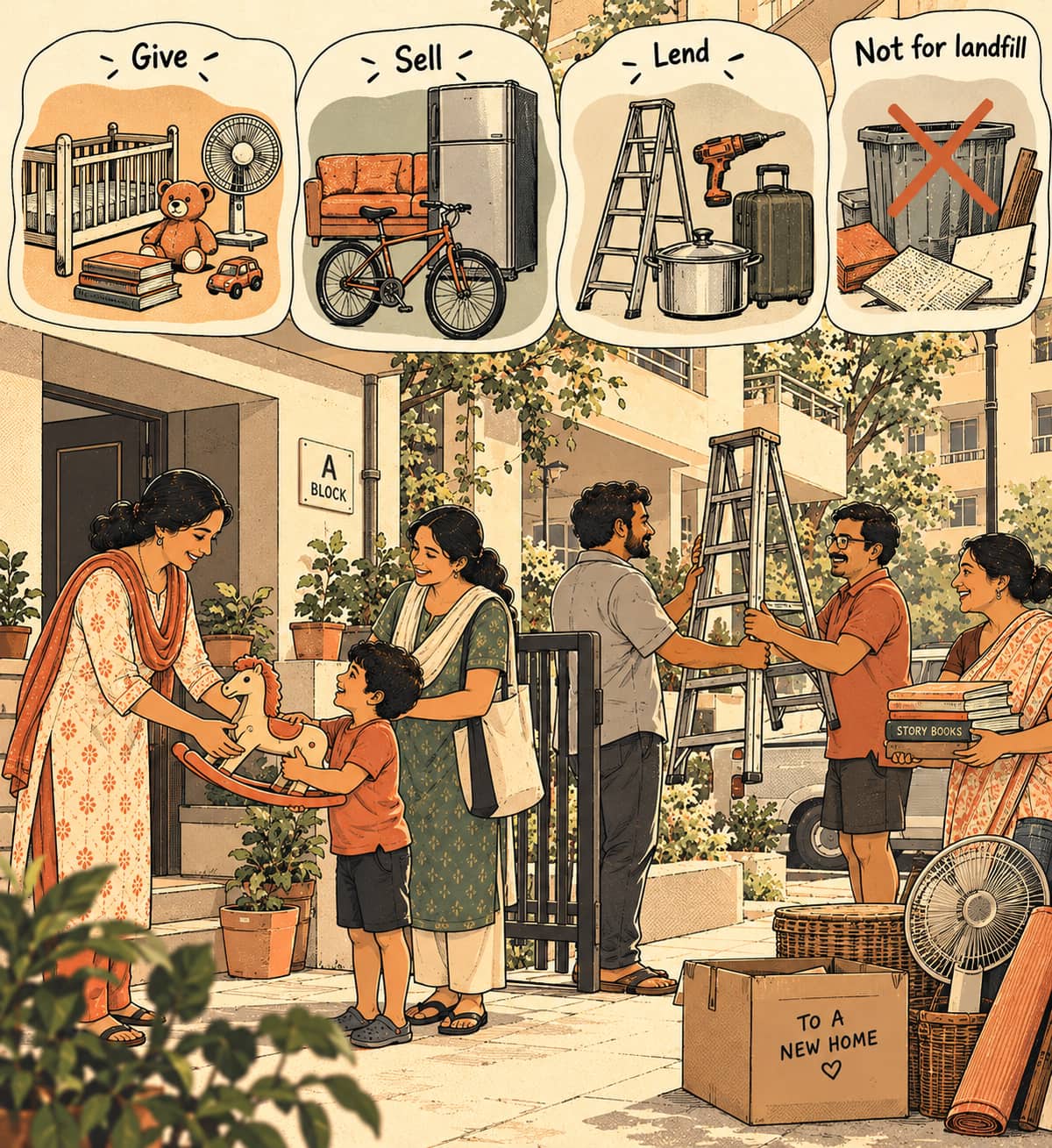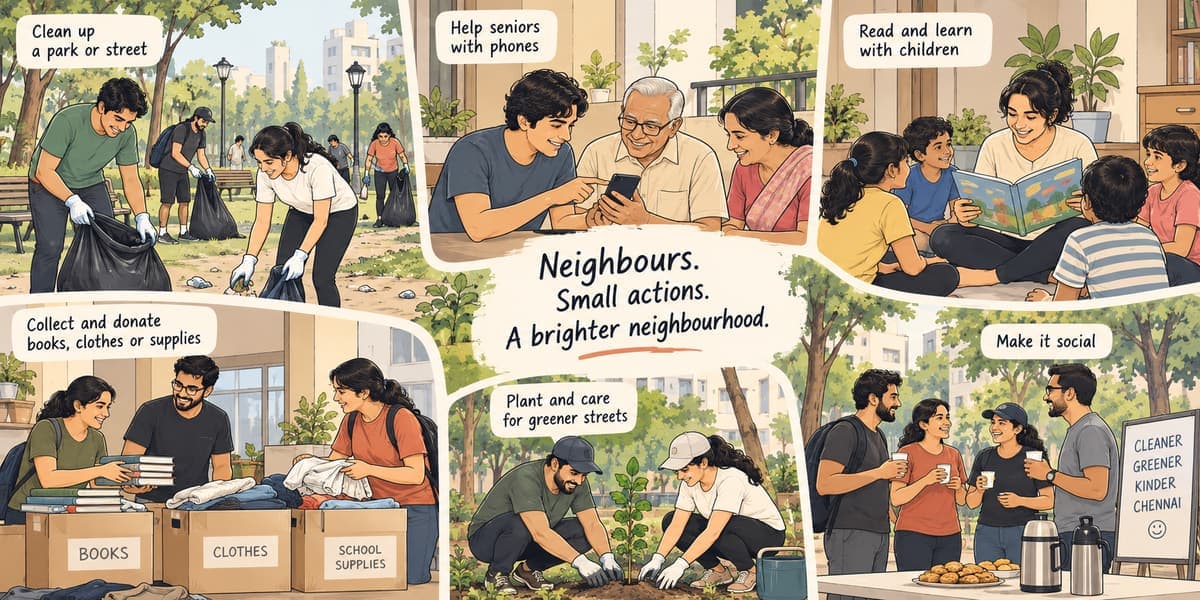
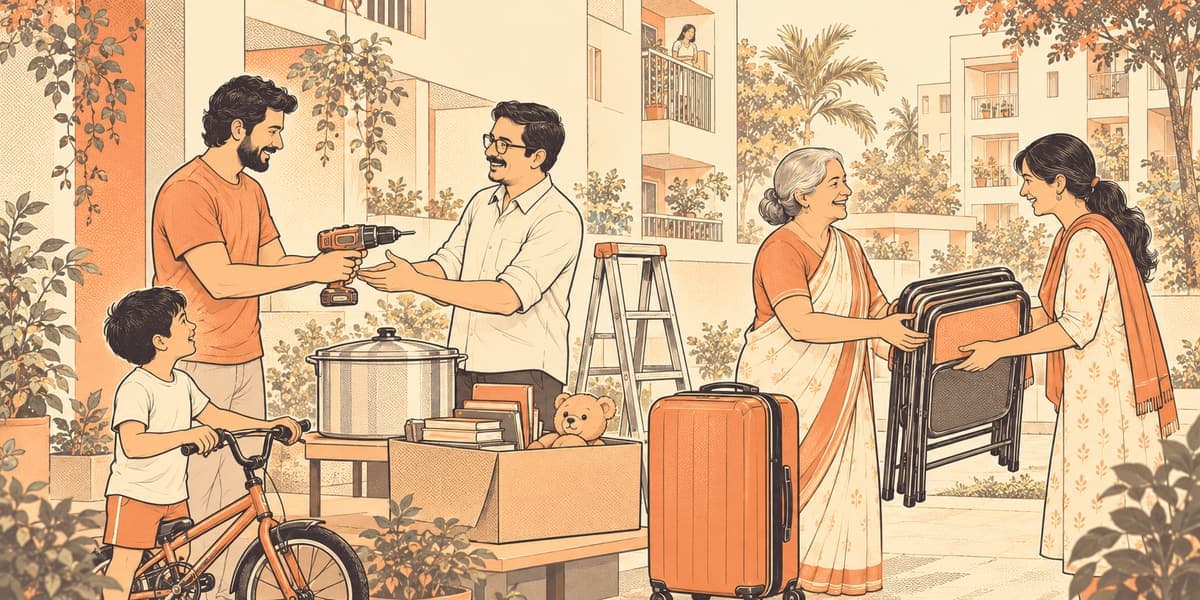
- Lend tools, function items, travel gear and kids' things that you use rarely but own for years.
- Share through group buys, composting, school books, rides and skills to cut costs together.
- Before something goes in the bin or the raddi pile, check whether a neighbour could use it.
Count the things in your home that you used once last year. The drill bought for one set of curtain rods. The big biryani vessel that comes out only for a housewarming. The ladder, the suitcase for the one trip abroad, the folding chairs for a family function, the baby carrier your youngest has long outgrown.
Now picture the same list in every flat in your building. A forty-flat apartment in Anna Nagar might hold forty drills between them, most of which have been used for a few minutes in their whole life.
Sustainable living often sounds like a big, expensive project: solar panels, electric cars, special products. In a neighbourhood, a lot of it is much simpler. Lend what you rarely use. Share what is cheaper together. Pass on what you no longer need. Your neighbours are already the closest library, tool shed and swap shop you have.
Lend: the things you need once and own forever
Lending works best for items that are expensive, bulky or rarely used. Good candidates:
- Tools. Drills, ladders, extension boards, a pressure washer, garden shears.
- Function things. Large vessels, extra chairs, a tent or shamiana frame, serving trays, a water dispenser.
- Travel things. Big suitcases, a car roof bag, a child's car seat for a visiting grandchild.
- Kids' things. A cycle they will outgrow by next summer, a costume for the school annual day, a science-fair kit.
A few simple ground rules keep lending friendly:
| Before you lend | Why it helps |
|---|---|
| Note the condition, even with a quick photo | No arguments later about a scratch that was already there |
| Agree a return date | "Sometime next week" becomes "never" surprisingly fast |
| Explain how to use it | Saves the item, and sometimes a finger |
| Agree what happens if it breaks | Repair, replace or split the cost, decided calmly upfront |
| Say thank you both ways | The lender trusted you; the borrower looked after it |
Share: cheaper and lighter together
Sharing is a step beyond lending. Instead of one person owning something, several households pool together.
- Group buys. Ten families ordering rice, cold-pressed oil or mangoes in bulk from one farm cuts down packaging and trips, and often the price.
- Compost. A shared compost bin in the apartment garden takes care of wet waste for several flats and feeds the plants downstairs.
- School books and uniforms. Siblings across the floor often go through the same syllabus a year apart. Pass the books down instead of buying new.
- Rides. Two families in Porur going to the same school or the same office park on OMR can take turns. Fewer cars, calmer mornings.
- Skills. One neighbour can fix a mixer, another can hem a saree blouse, another can help a teenager with physics. A skill shared is a purchase avoided.
Reuse: give things a second life nearby
Before something goes into the bin or the raddi pile, ask whether a neighbour could use it. A working fan, a study table, a stack of jars, school bags, old cotton sarees for quilting, packing boxes after a move: each is somebody's perfect find.
Reuse feels easier when the person picking it up is a few doors away. There is no shipping, no waiting and often a friendly chat at the gate. Our piece on giving pre-loved items a new home covers the giving-away side in more detail, and could your unused items be someone else's perfect find is a good nudge to start sorting.
A small habit helps: keep a box near the door for things you plan to pass on. When it is full, post them together.
Where Zinola fits
Zinola is a free neighbourhood app for Chennai, and its marketplace has listing types that suit lending, sharing and reuse, not only selling.
- To lend. Post the drill or the folding chairs as a To lend listing. The listing keeps track of whether the item is lent or returned, so you are not trying to remember who has your ladder.
- Free. Giving something away? A Free listing tells neighbours it costs nothing. Pre-loved items has its own category too.
- Wanted. Looking for a ladder for one afternoon? Post a Wanted listing and see whether a neighbour has one.
- Group buy. Inside a circle, members can start a group buy from the chat or the board, so the bulk rice order has a clear list of who is in.
- Private chats, numbers hidden. People tap Ask about it to message you privately. Your number stays hidden unless you choose to share it.
- You choose who sees it. Show a listing only to your circles, or to chosen areas nearby. Nearest listings come first.
Zinola does not handle money or pickups. Any exchange is arranged directly between neighbours. For a step-by-step walk through posting, see how the neighbourhood marketplace works.
Start with one shelf
You do not need to organise a building-wide tool library on day one. Start with one shelf in your home. Pick three things you rarely use and offer to lend them. Pick three things you no longer need and give them away. See who responds.
Most people find that lending a ladder leads to a conversation, which leads to the borrower offering their own pressure cooker for your next function. That is how a sharing habit grows on a street: one exchange at a time, with a little trust each way.
If your street also likes reading, a shared shelf of books is a natural next step, and starting a book club in your neighbourhood shows how to turn it into a regular meetup.
Questions people ask
- How do I lend something to a neighbour on Zinola?
- Post a To lend listing in the marketplace. It keeps track of whether the item is lent or returned, and neighbours message you privately with Ask about it.
- Can I give things away for free on Zinola?
- Yes. Use a Free listing, and choose who can see it, such as only your circles or nearby areas. The person picking it up arranges it with you directly.
- Does Zinola handle payment or pickup?
- No. Zinola doesn't handle money or pickups. Neighbours arrange any exchange directly with each other.
- What should we agree before lending an item?
- Note its condition, agree a return date, explain how to use it and decide upfront what happens if it breaks.
Lend or pass something on today
Post a To lend or Free listing on the marketplace and see which neighbour needs it.
Open the marketplace